

America’s Next Discovery Engine
Takeaways from SCSP's AI+ Discovery Summit

Hello, I’m Ylli Bajraktari, President of the Special Competitive Studies Project. In this edition of our newsletter, the team shares some of the key highlights from the AI+ Discovery Summit we hosted last week here in Washington, D.C, which brought together over 300 attendees and close to 30 speakers. Check out our YouTube page to watch some of the sessions in full. Thanks to all the speakers and guests who participated!
Nations do not usually get to choose the moment when the method of science changes underneath them. New instruments arrive, the practice shifts, and the countries that adapt fastest set the terms for everyone else. Discoveries including the telescope, microscope, particle accelerator, and digital computer each redrew the boundary of the knowable, and each rewarded the societies best organized to adopt and exploit it.
We are living through such a moment now, and the United States has decided, for the first time in a generation, to treat it as a matter of national strategy rather than a matter of scientific curiosity. That was the animating premise of SCSP’s AI+ Discovery Summit, which convened government leaders, laboratory directors, allied officials, investors, and founders to ask a deceptively simple question: if artificial intelligence is genuinely changing how discovery works, what must America build to stay ahead of it?
Six themes emerged from the Summit.
1. Overcoming Compute, Data, and Organizational Bottlenecks
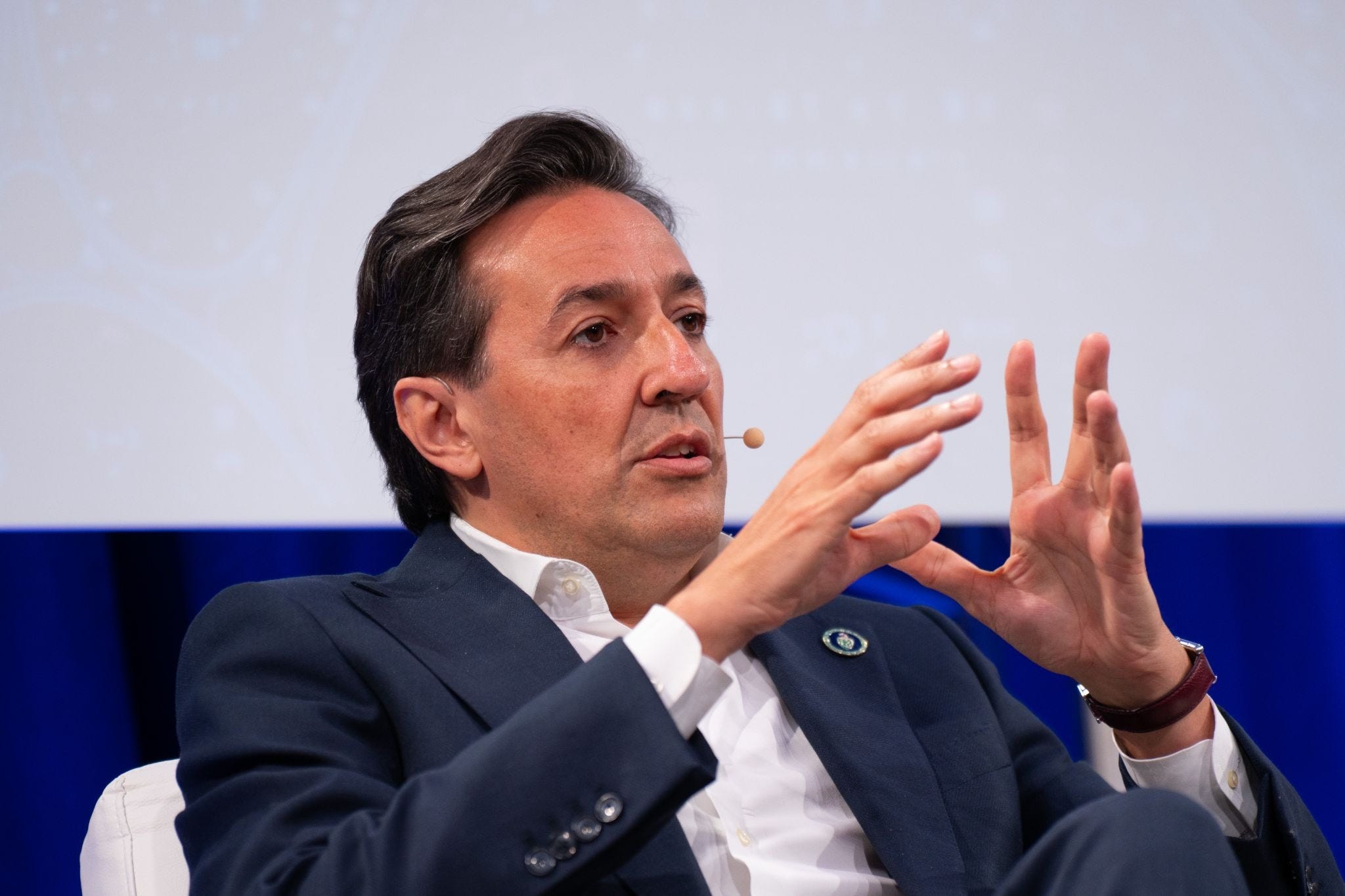
To ensure U.S. scientific advantage, Under Secretary for Science Darío Gil, who directs the Genesis Mission at the U.S. Department of Energy (DOE), framed the task ahead as building a national platform that connects the country’s best computing capabilities to the scientists who need it. This is done through what he described as an “internet of science”, capable of orchestrating agentic workflows across disciplines. When asked what stands in the way, his answer was institutional rather than technical. Even the most prestigious American universities, he observed, have not yet cracked the code on how to incorporate AI into their research enterprise. The labs and the academic community must be equipped to leverage the technology, which means giving scientists tools that they do not currently possess.
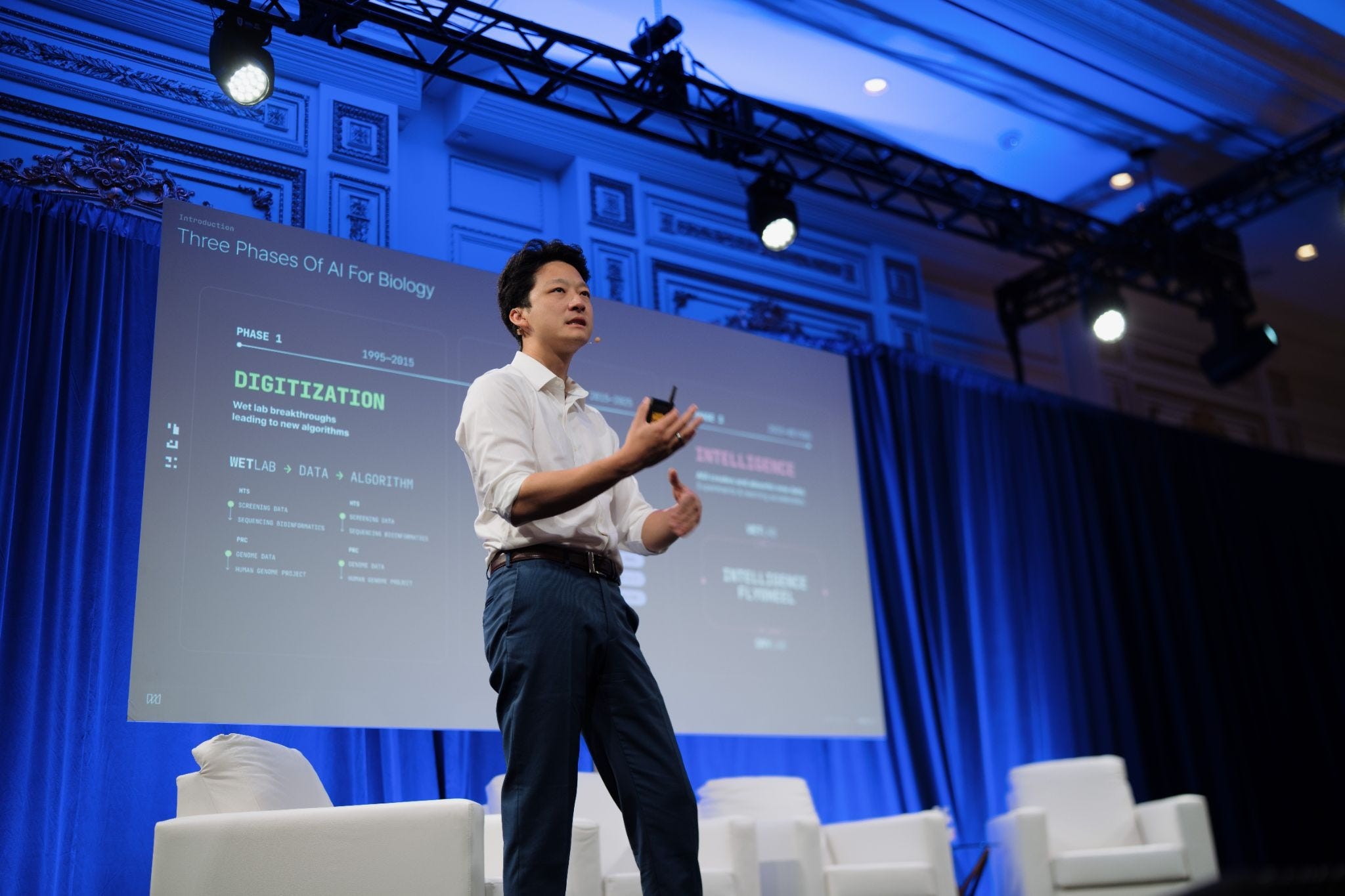
This is the uncomfortable finding of the Summit, and it recurred in nearly every session. Dylan Qian from Medra emphasized that, in life sciences, it has taken twenty years to automate roughly five percent of instruments. The problem is not robotics. It’s data. At scale, experimental design and validation have become decoupled, and the tacit knowledge of the working scientist—everything a good researcher knows instinctively—isn’t captured in the published output. Ron Alfa from Noetik noted that there is a similar problem with clinical data: trial results frequently have no repository at all, and when a trial’s sponsor ceases to exist, the data simply disappears.
While compute remains important, America’s comparative advantage in it will not convert into scientific advantage without data. This will require the institutional will and standards to ensure that data does not get lost in the labs, and is instead prioritized and cataloged for future use.
2. The Genesis Mission: A National Response
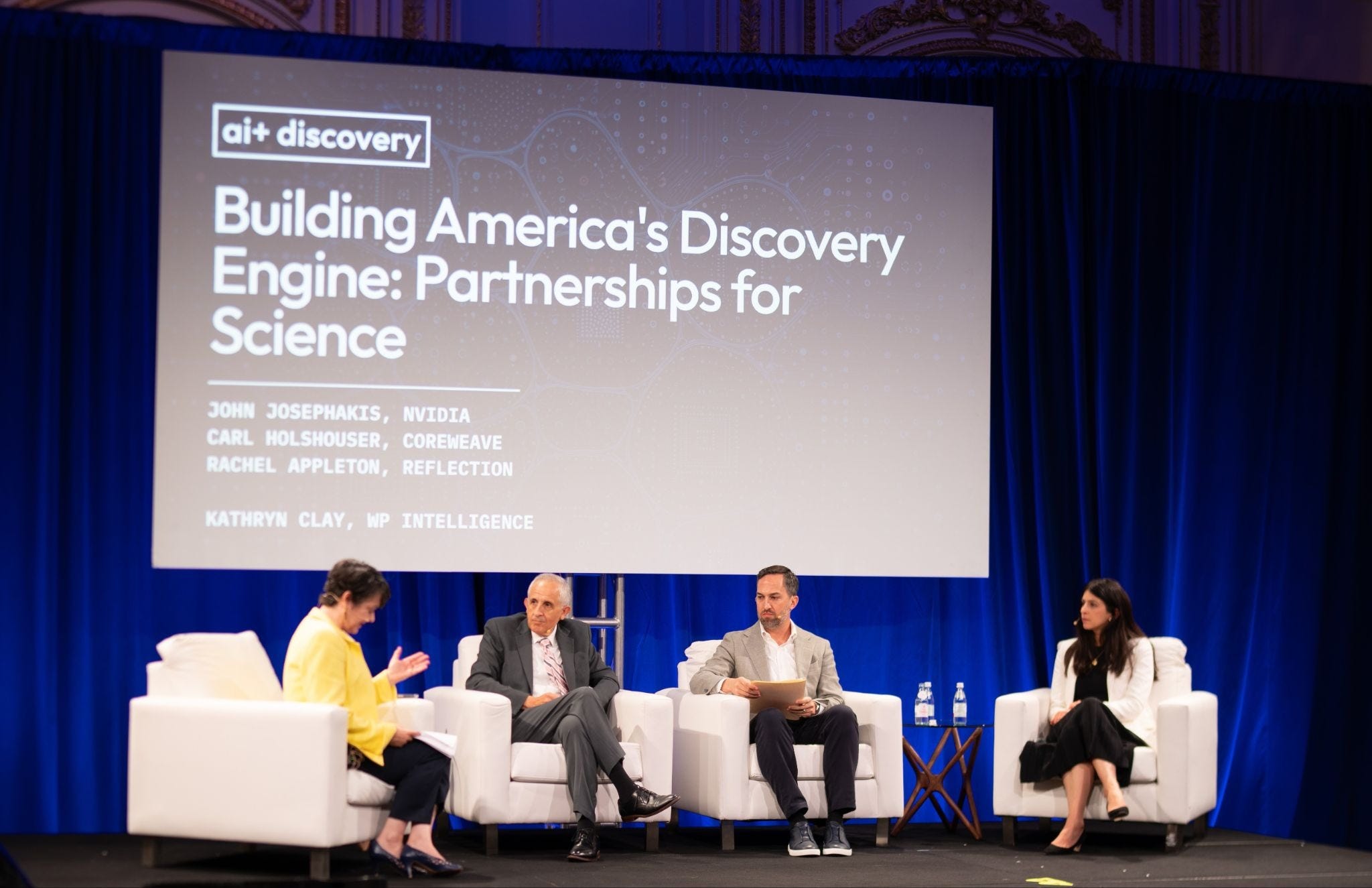
The response to Genesis has been extraordinary. Under Secretary Gil reported more than 5,000 proposals from roughly 500 institutions — a level of mobilization that suggests the scientific community does not regard AI-enabled discovery as a futuristic proposition but as a present one.
Setting that against the fiscal scale of the enterprise: the United States invests roughly a trillion dollars annually in research and development (R&D), with the private sector supplying the large majority, and will invest an estimated fifteen trillion dollars over the coming decade. The challenge Genesis faces is ensuring that AI is leveraged across every STEM discipline so the United States competes beyond spending.
3. National Laboratories: Untapped Engines of Scientific Discovery
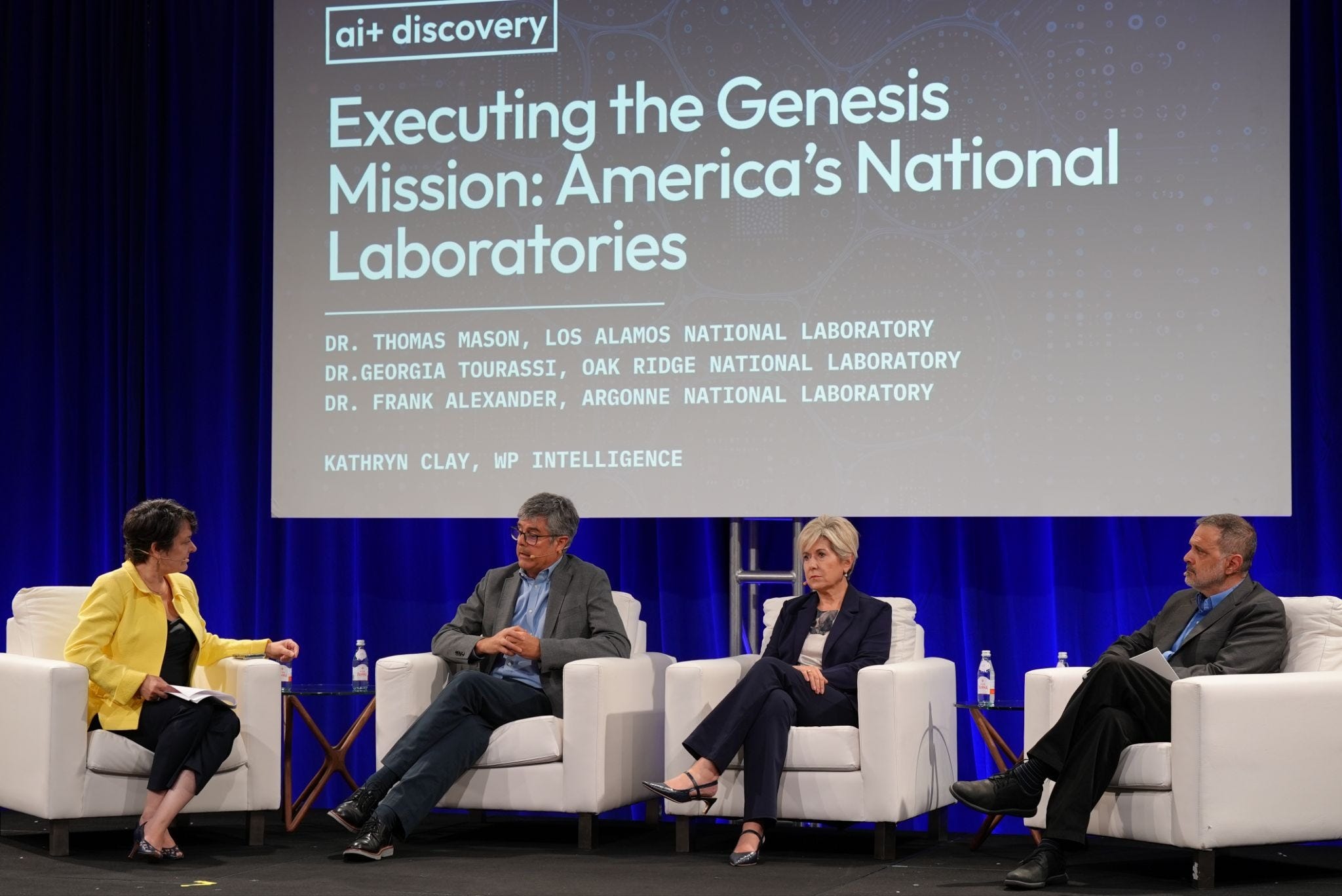
The National Labs’ distinctive strength is in their scale: the ability to direct thousands of people at a single problem, all integrated across data, software, and instruments. The robust scientific workforce at the labs can often pivot to new challenges considerably faster than academia can. The ultimate goal is to free scientists from institutional boundaries, resulting in less time spent managing research and more time doing it. Additionally, the labs serve as trusted evaluators of AI technology itself, a function no company can perform for itself and no university is presently resourced to perform at scale.
On the tension between multi-year grant cycles and a research process that now moves in weeks, panelists highlighted the importance of holding firm to the mission, but staying nimble about the method. Fund the scientific outcomes, but leave the path flexible.
4. Funding Inertia: The Bottleneck in AI-Driven Science
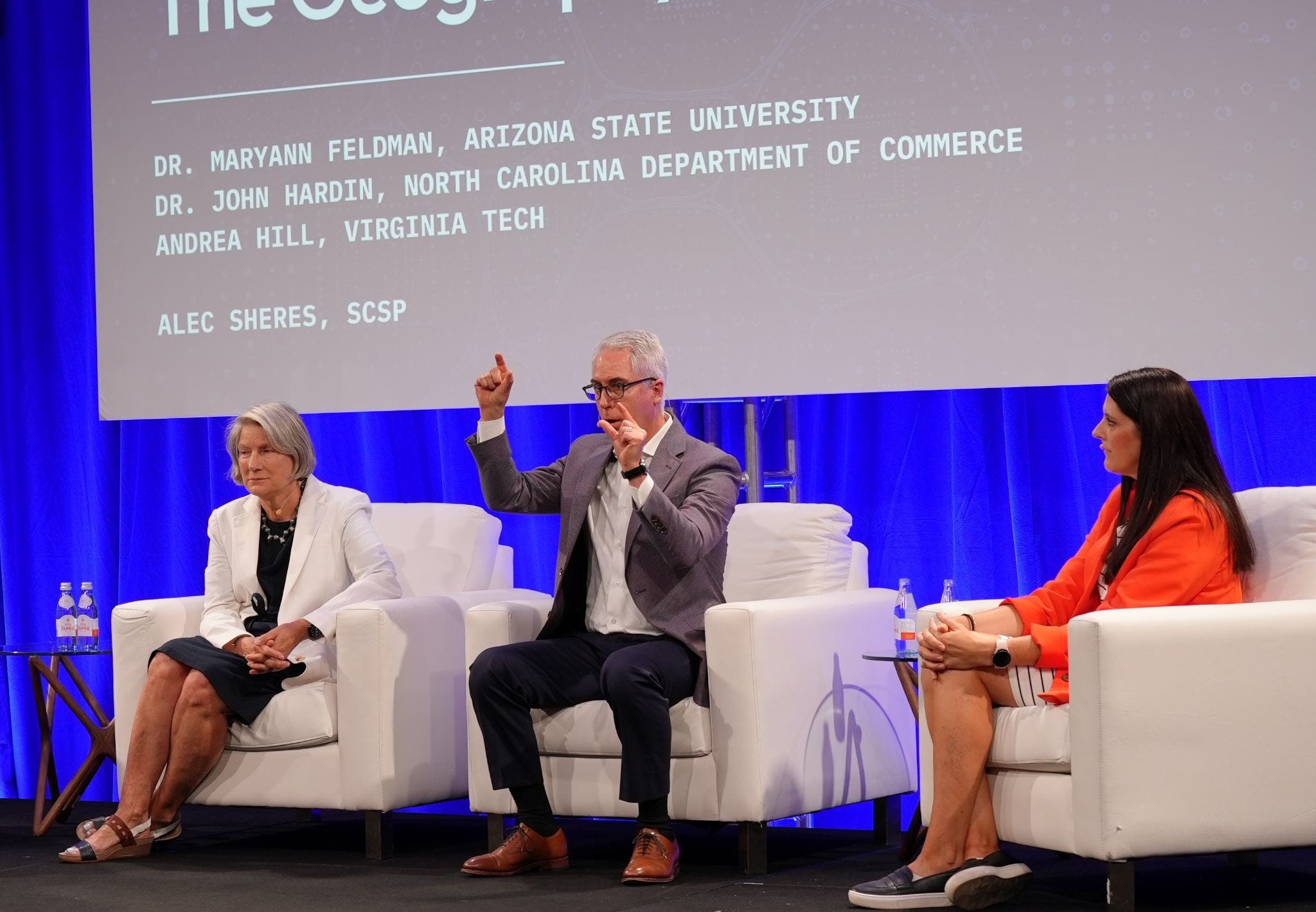
If the research cycle has compressed, the funding cycle has not. The Summit’s funding panel acknowledged that these two timelines are now drastically mismatched. While fast-grant experiments born during the pandemic were referenced as proof that speed is achievable, those mechanisms have not scaled nationally. This gap in science and technology funding has been a direct brake on the pace of innovation within the United States, and increased buildout of test beds and benchmarks are needed to scale national capability without compromising product and scientific development. The regional dimension compounds the funding problem. Leaders at local levels traced how deliberate mid-century investment built the Research Triangle, and argued that the federal government’s irreplaceable roles are agenda-setting and de-risking early-stage technology. They also made the case for more non-dilutive capital to move discoveries out of laboratories to ensure good ideas don’t get trapped, and warned that innovation requires certainty and risk reduction. Both are currently in short supply.
5. The Interpretability Gap: Ensuring Scientific Oversight

In a session on the future of science, panelists raised the prospect of a future in which we do not understand the discoveries that AI produces for us, and argued that we need ‘symbiointelligence,’ or a genuine partnership with these systems, while warning that the institutions responsible for explainability are being eroded precisely as the need for them grows. Olaf Groth from Cambrian Futures outlined three archetypal futures, including one in which the United States and China harness abundant energy for their own scientific advancement and the rest of the world becomes an order-taker.
One of the sharpest challenges is our readiness. After nearly two decades working in and around national security institutions, Jacqueline Tame from Playground Global described walking into the Pentagon and intelligence agencies and finding not merely the same challenges but the same words on the same whiteboards.
Nathan Frey from Anthropic offered a constructive counterpoint from the model developer’s perspective, describing an approach oriented toward scientific outcomes rather than benchmark metrics, and toward features that working scientists actually require: oversight of the work and chain of custody for results. That is the right instinct, and it points to the institutional answer to concerns about understanding: explanation will be preserved by design choices and professional norms, or it will not be preserved at all.
6. Latent Scientific Potential in Global Alliances
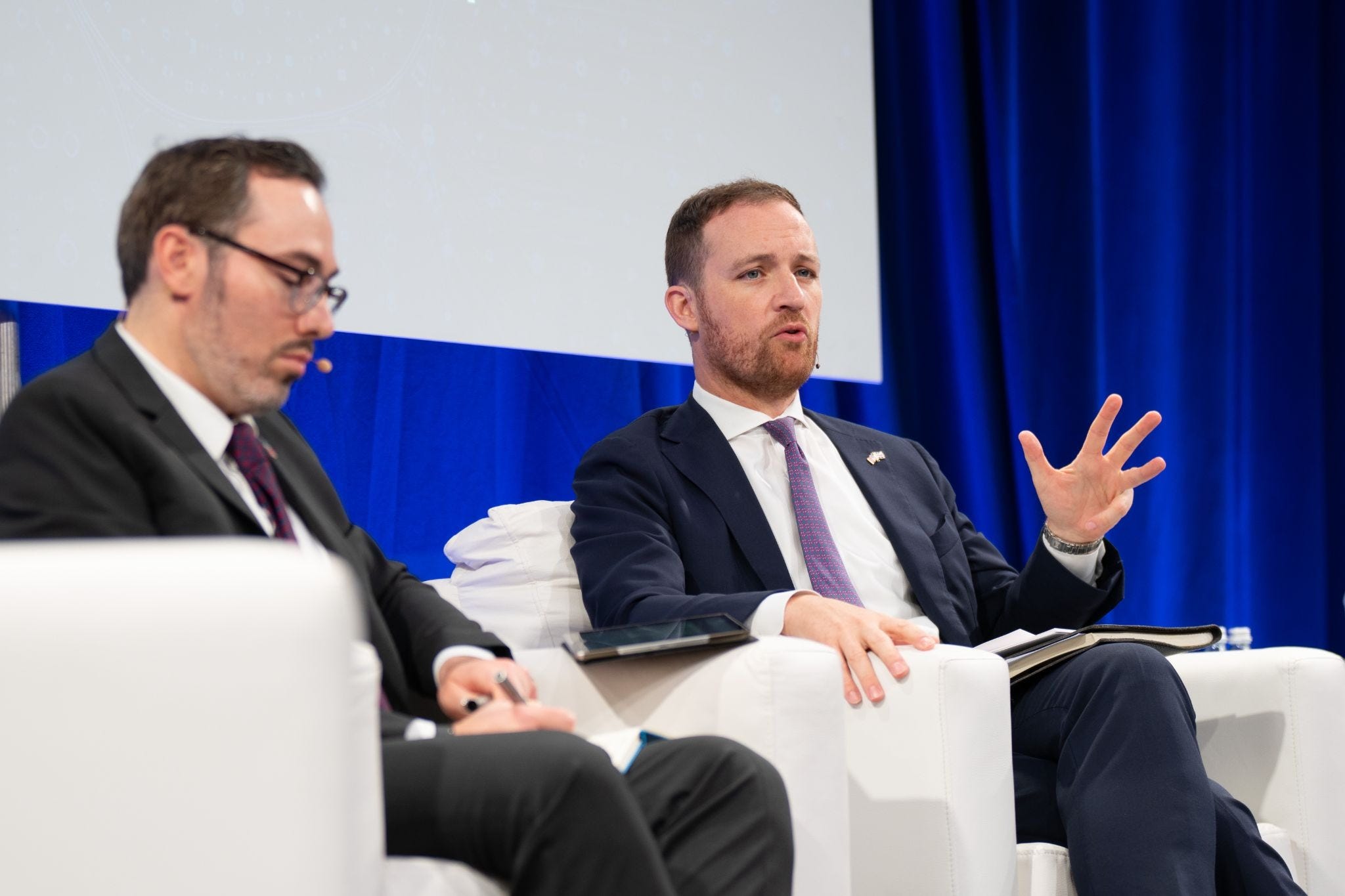
The Summit’s international sessions made the case that alliances are a real scientific capability. Minister Counsellor Mungo Woodifield of the British Embassy described the United Kingdom’s AI-for-science strategy as resting on four pillars: datasets, compute access for researchers, talent, and automated research — backed by public commitments to science and technology running to roughly £110 billion through 2030, alongside targeted vehicles including a sovereign AI fund and dedicated fundamental AI laboratories. His most consequential proposition was the simplest: pair American compute with British data. The National Health Service holds population-scale datasets of a kind no U.S. institution can replicate, and making them AI-ready is a deliberate national project.
From the European side, André Loesekrug-Pietri of the Joint European Disruptive Initiative offered both an opportunity and a warning. He described this as a “golden year of science” in which scientific validation, with the help of AI, has been radically accelerated. He was also blunt about Europe’s dependence: the continent relies entirely on American GPUs, and continues to work in silos rather than engaging the broader ecosystem strategically. His prescription: Europe should stop trying to out-compete Chinese manufacturing and instead make calculated bets where its industrial base and mathematical traditions give it genuine advantage.
The AI+ Discovery Summit made it abundantly clear that the scientific community no longer views AI-enabled discovery as a futuristic proposition, but as an urgent present reality. To maintain its competitive edge, the United States must go beyond simply leading the world in compute and private capital. We must fundamentally rewire our institutions to prioritize data, leverage our international alliances to pair American computing power with global datasets, and modernize our funding mechanisms to match the accelerated speed of innovation.
Ultimately, the challenge of this technological shift is not merely technical, but organizational and strategic. As we navigate this new era of discovery, the United States must adapt its scientific enterprise rapidly, recognizing that the nations that organize fastest around these new tools will set the terms for everyone else.
Killer