


Hello, I’m Ylli Bajraktari, President of the Special Competitive Studies Project. In today’s newsletter, Associate Director for Foreign Policy Channing Lee discusses the release of her new report on the global electric vehicle competition.
China Isn’t Just in the EV Race — It’s Winning It
Next week, more than 40,000 people will gather in Shenzhen for Automotive World China (AWC) to see and discuss the future of new energy vehicles, intelligent connected vehicles, and automotive engineering and manufacturing. The exhibition will showcase not only China’s latest and flashiest tech, but also their position as a global leader in the next generation of automobiles.
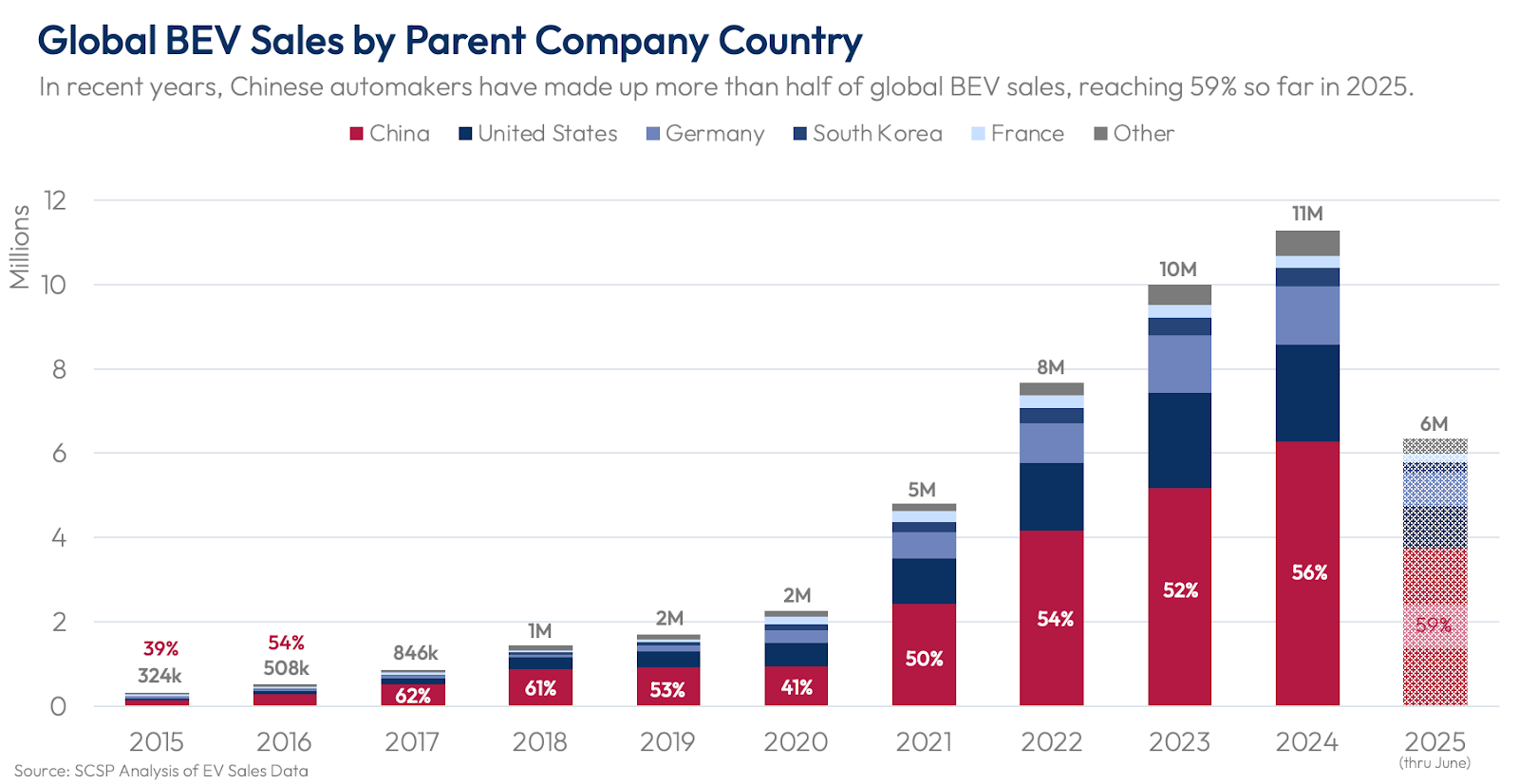
Within a decade, Chinese automakers have gone from laggards to leaders — commanding nearly 60% of the global battery electric vehicle (BEV) market while the U.S. hovers at just 16%.
China’s rise didn’t happen by chance. It’s the result of over two decades of deliberate industrial strategy, from the National Medium- and Long-Term Plan for Science and Technology Development (2006-2020) to Made in China 2025 to the current 14th Five-Year Plan, each treating EVs not as cars, but as strategic technology platforms.
The data from SCSP’s new report, Charging Ahead: How China is Driving Innovation to Dominate the Global Electric Vehicle Market, tells a clear story: Beijing has built the future of mobility — and it’s doing so faster than anyone else.
The Rise of a BEV Powerhouse
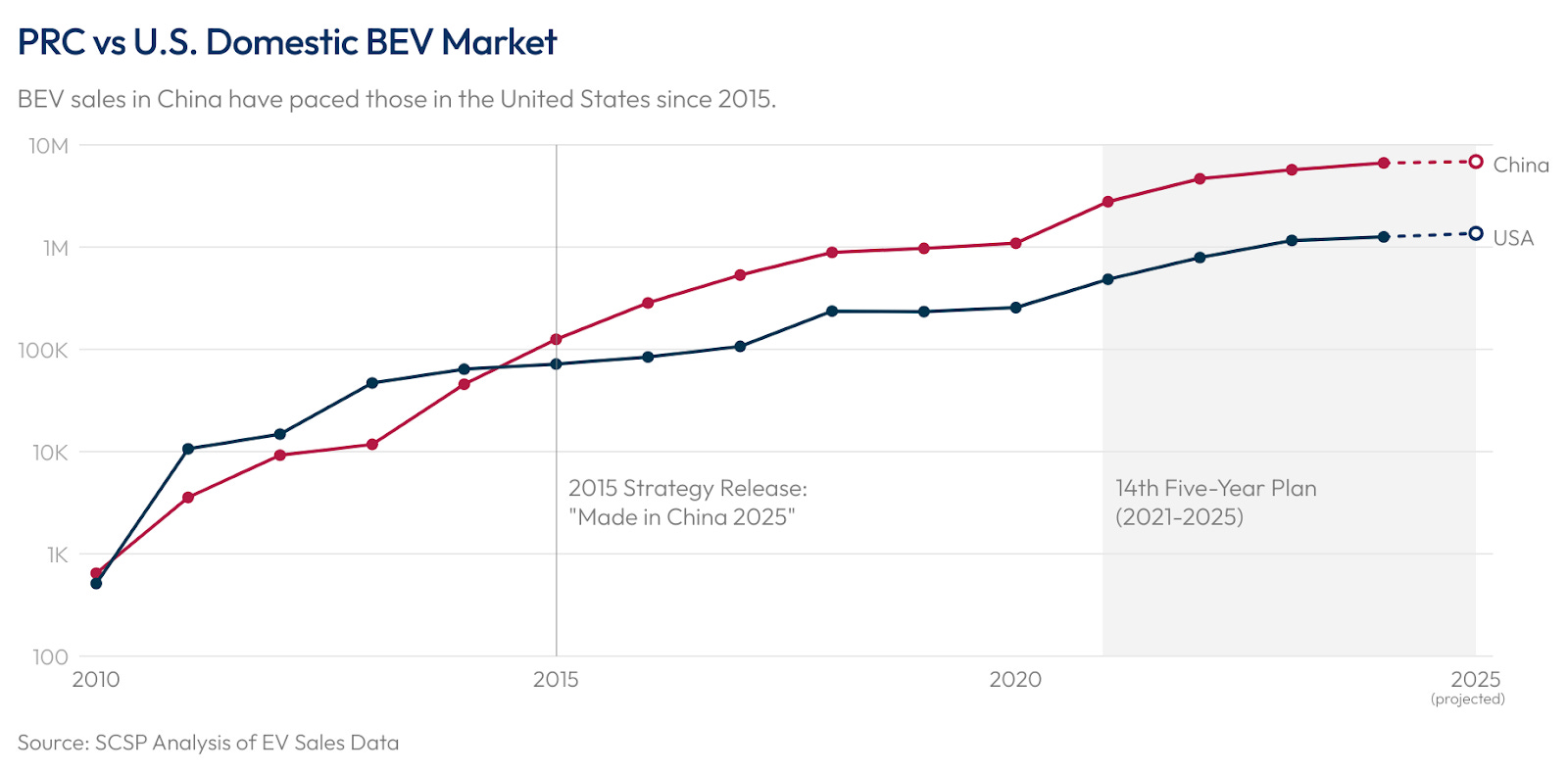
In 2015, China overtook the United States in domestic battery electric vehicle sales. Within a decade, that lead had become overwhelming: 6.7 million BEVs were sold in China last year, compared to 1.3 million in the United States. (Proportional to our countries’ populations, China still sold more.)
The PRC now produces the majority of BEVs sold worldwide. And unlike legacy auto industries that evolved organically, Beijing’s success came from top-down coordination — state subsidies, provincial competition, and massive infrastructure buildouts.
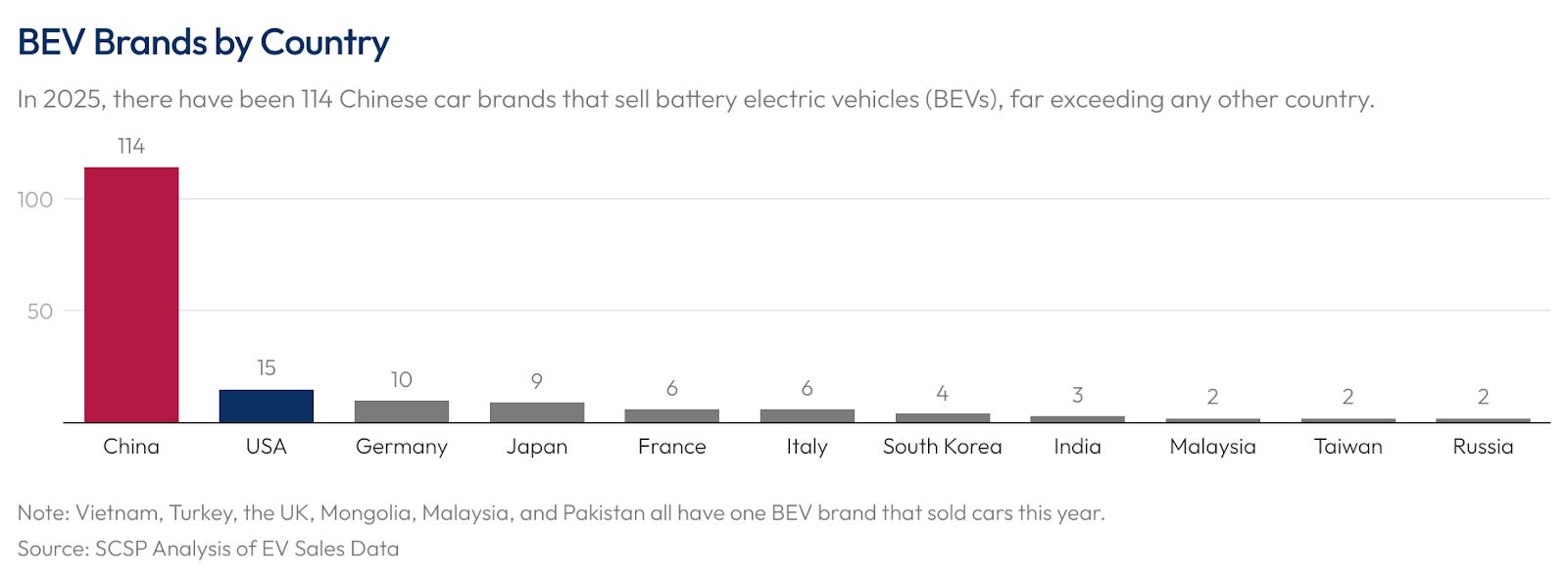
Today, China has 114 BEV brands (compared to just 15 U.S. brands). Many of these are startups, focused on rapid innovation, developing key components like batteries and software in-house, and viewing BEVs as software-defined platforms rather than mechanical products. Functioning as tech companies — raising capital, rapidly scaling with strong state support, and integrating with broader high-tech ecosystems — has afforded Chinese EV firms the agility and adaptability that Silicon Valley’s Big Tech once enjoyed.
BYD, Among China’s “Big 3”
At the center of this revolution are three industrial giants — BYD, SAIC-GM-Wuling, and the Zhejiang Geely Holding Group — together selling more than 11 million BEVs in the last three years.
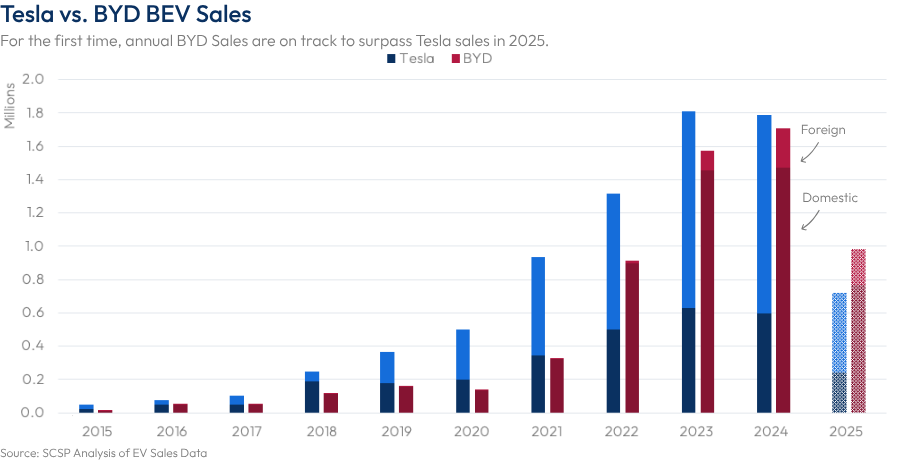
BYD, once a small battery firm, has now overtaken Tesla as the world’s top BEV manufacturer. Its Zhengzhou Gigafactory became the world’s largest EV plant in just four years.

Geely, which bought Volvo in 2010 (and acquired Polestar in 2015), merged Scandinavian engineering with Chinese innovation, while SAIC-GM-Wuling captured the mass market with ultra-affordable mini EVs that sell for under $5,000.
These firms are not just carmakers — they operate at the intersection of manufacturing, data, and strategic power.
From Domestic Dominance to Global Reach
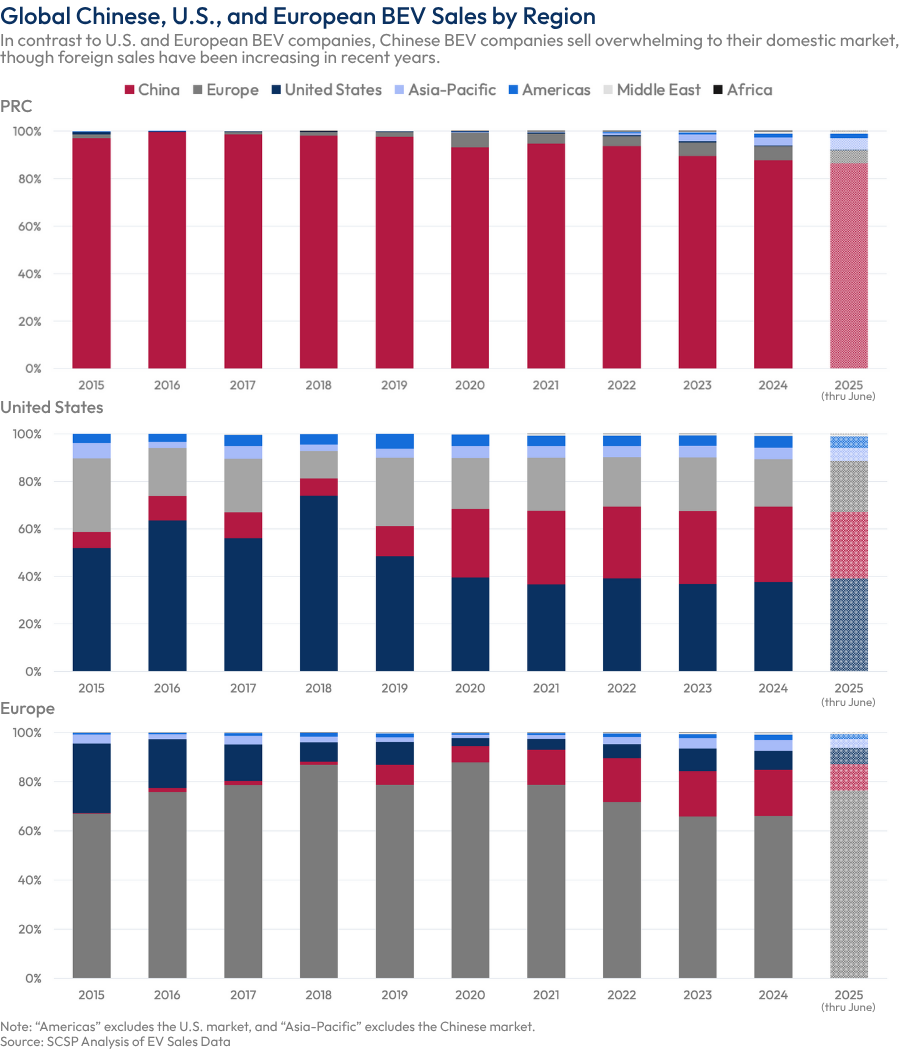
Over the last decade, Chinese EV makers sold almost exclusively at home. In contrast, an average of about half of American BEVs were sold in the United States, while over three-quarters of European BEVs were sold in Europe.
But that’s changing quickly. In 2015, just 3% of Chinese BEV sales were abroad. This year, 14% are — and rising.
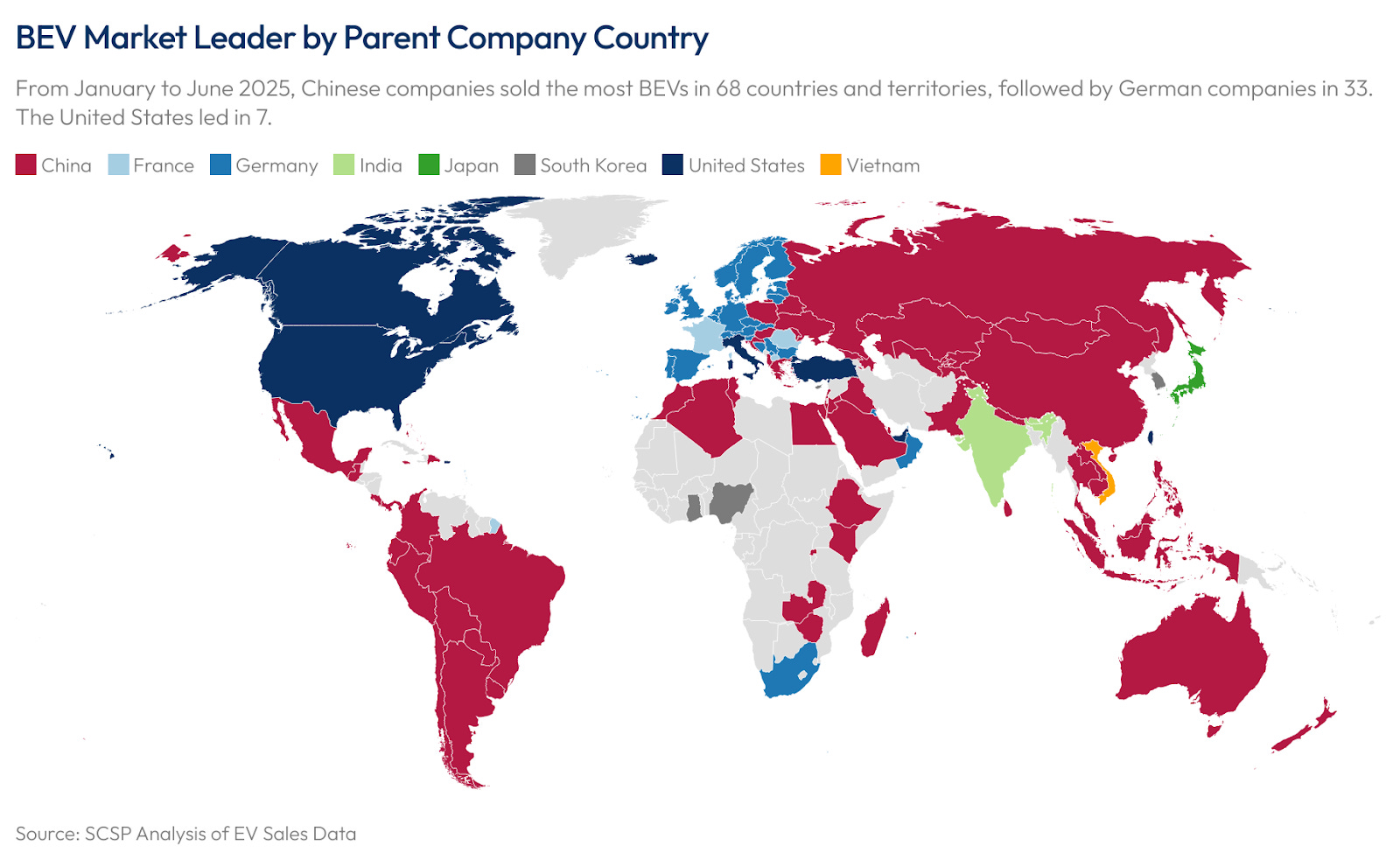
Where American and allied legacy automakers have focused on wealthy markets, Chinese companies have gone everywhere — Latin America, Southeast Asia, Africa — combining low prices with attractive financing and quick setup of assembly plants. From Thailand to Brazil, Chinese firms are investing billions into building new factories. Chinese automakers now outsell U.S. ones in 68 countries and territories, many in which American companies aren’t even present. The United States leads in just seven.
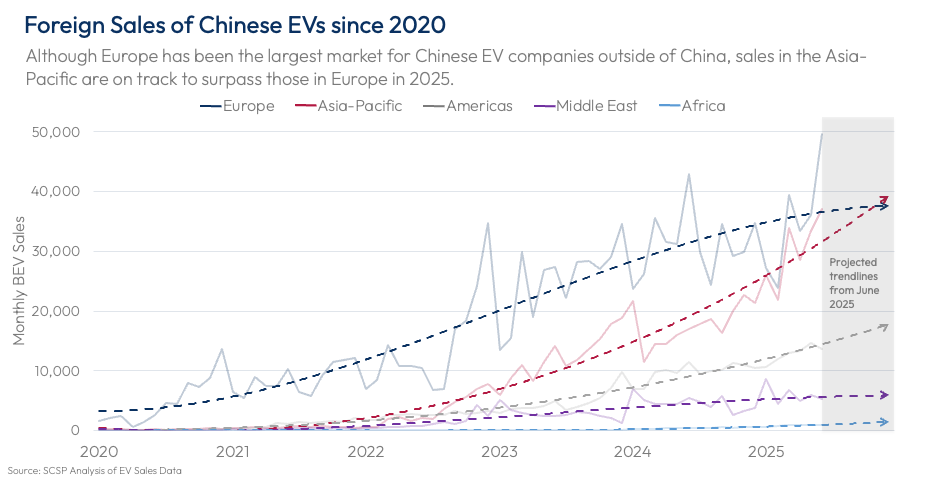
Outside of China, Europe has been the biggest market for Chinese BEVs, largely due to Geely’s ownership of Volvo. However, sales in the Asia-Pacific are rapidly increasing — primarily dominated by indigenous Chinese brands like BYD — and on track to surpass Europe as the top destination for Chinese BEVs by the end of 2025.
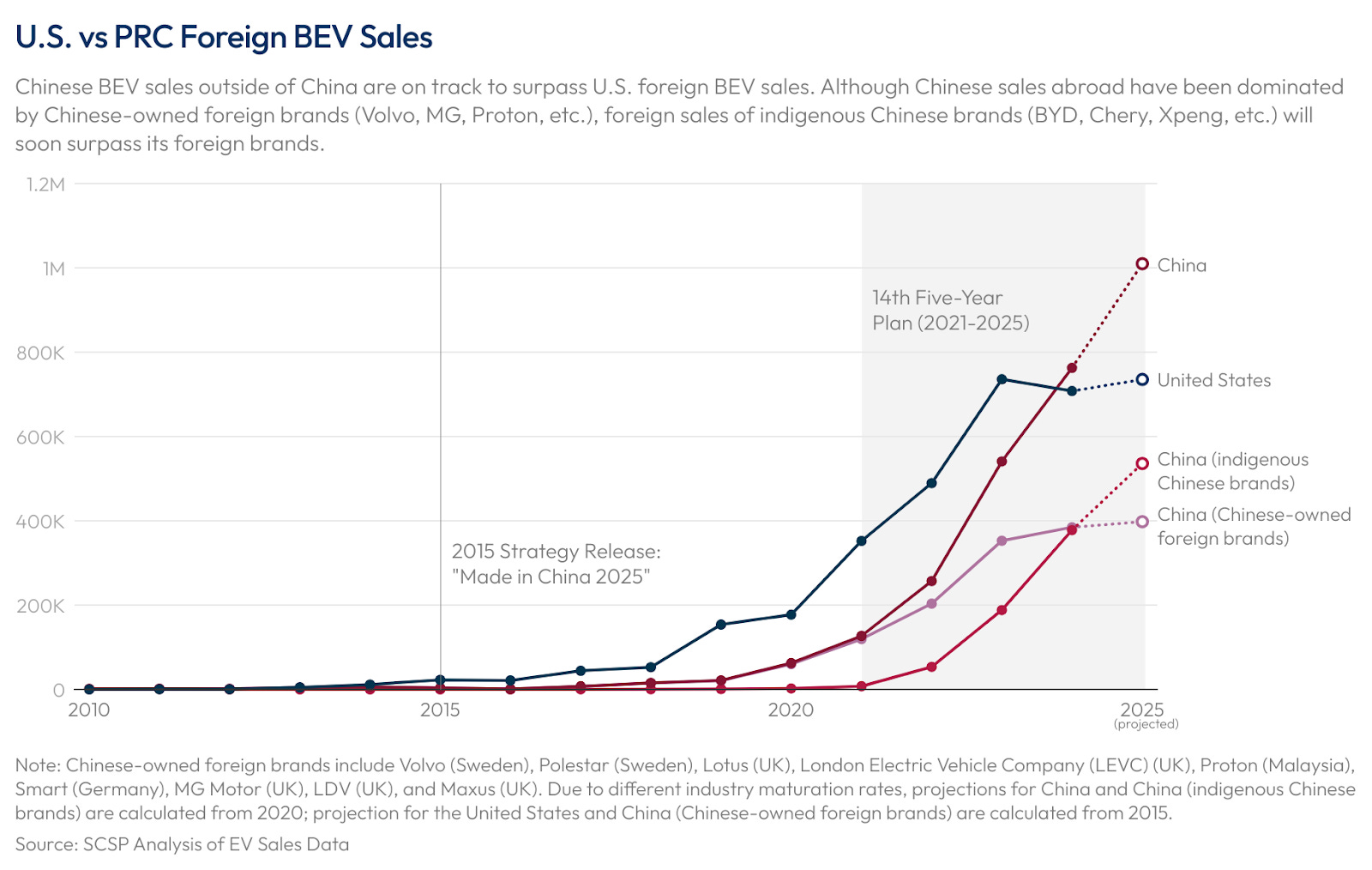
If we think of BEVs as a tech export, the competition isn’t looking great: foreign Chinese BEV sales are growing more rapidly than foreign American BEV sales. In fact, American BEV sales abroad are either slowing down or plateauing. While Chinese sales overseas have historically been led by foreign brands that Chinese automakers own (Volvo, Polestar, MG Motors, Smart, etc.), trendlines reveal that sales of indigenous Chinese brands (BYD, Chery, NIO, Xpeng, etc.) are increasing faster — on track to surpass them.
The Innovation Game
China’s BEV success is about much more than cheap cars. It’s about innovation power.
Chinese EVs are now introducing new features, such as:
Ultra-fast charging (five-minute full charge in BYD’s Super-E stations)
AI-powered driving and adaptive systems
Augmented reality entertainment and zero-gravity seating
Companies like Xpeng and Chery are designing cars that double as mobile living spaces — and BYD has even integrated DJI drone platforms into its newest models.
Meanwhile, Tesla’s global sales have declined, and its overseas presence has stagnated. The balance of innovation — once America’s advantage — is now tilting toward China.
The Stakes for America
China’s EV rise matters for three reasons: economic competitiveness, innovation leadership, and national security.
1. Economic Competitiveness
EVs touch every layer of modern industry — batteries, semiconductors, robotics, energy, and AI. Losing this race means ceding the core of 21st-century manufacturing. The report finds that more than five times more BEVs are sold in China than in America, and Chinese automakers are growing their sales in every region of the world.
2. Innovation Leadership
Beijing’s success in EVs disproves the notion that China can’t innovate. It has fused state planning with entrepreneurial execution to dominate a frontier technology — the same approach it is now applying to AI, robotics, and quantum computing.
3. National Security
Modern EVs are data machines — equipped with GPS, cameras, and constant connectivity. Chinese-made “smart cars” could become rolling data collectors, subject to China’s National Security and Intelligence Laws. If exploited, these vehicles could transmit sensitive data about users, locations, or critical infrastructure back to Beijing. Connected vehicles should be treated with the same security scrutiny as 5G networks.
A Reckoning — And Road Forward — for America
How did America allow China to pull so far ahead in the EV race? One explanation is that the United States never organized itself to make developing this sector a strategic priority.
China did the hard work of scaling investments for commercialization, developing the manufacturing base to produce EVs at scale, and building nationwide charging infrastructure that made owning a BEV practical for consumers. By contrast, the United States relied mostly on state-level initiatives and a limited federal purchase subsidy.
Competing in the EV era requires a whole-of-economy strategy, combining industrial policy, innovation investment, and security frameworks.
This means, at a minimum:
Rebuilding battery and critical mineral supply chains to reduce dependence on China.
Investing in domestic manufacturing to scale U.S. EV and battery production.
Fostering public-private innovation partnerships to keep American EVs competitive in cost and technology.
Working with allies to set democratic standards for data, mobility, and connectivity.
Treating vehicle data as a national security asset, not just a consumer privacy issue.
This is more than a car race — it’s a test of whether America can still lead in technological revolutions that shape global power.
The Bottom Line
China’s rise in the EV sector is a flashing indicator of Beijing’s broader techno-strategic ambitions. Battery electric vehicles sit at the intersection of supply chain resilience, data control, and advanced manufacturing — the building blocks of innovation power.
If America and its allies fail to act, they risk surrendering not just an industry, but the ability to set the rules of the road for the technologies that will define this century.