

Escape Velocity
Why America's Discovery Engine is a Strategic Asset — and What It Will Take to Keep It One

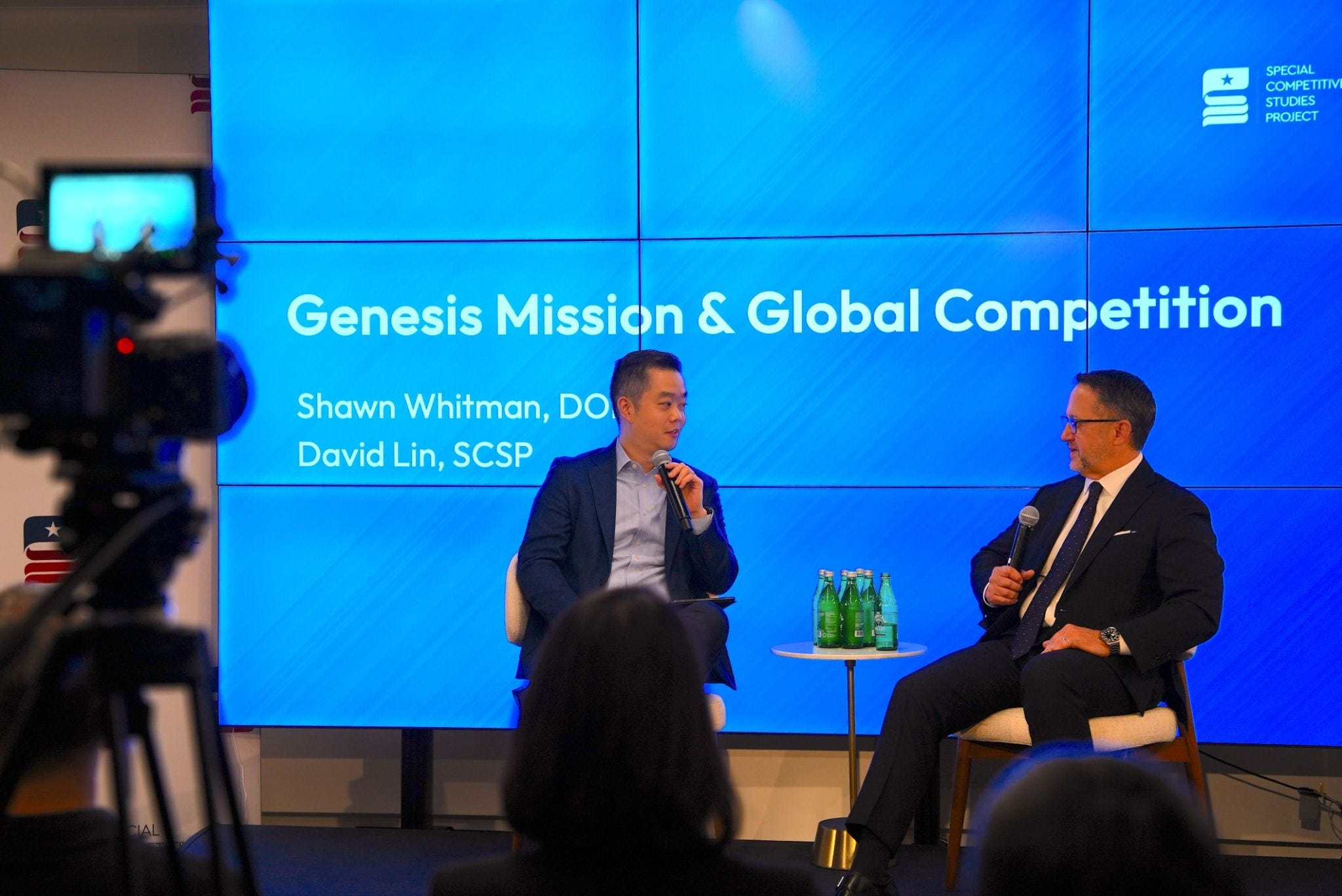
Hello, I’m Ylli Bajraktari, President of the Special Competitive Studies Project. In this edition of our newsletter SCSP’s David Lin and Nyah Stewart recap the inaugural workshop hosted with the Partnership for U.S. Leadership in Supercomputing, AI, and Quantum (PULS AIQ) and convened at SCSP headquarters in Arlington, Virginia. The workshop brought together senior officials from the Department of Energy, the Office of the Director of National Intelligence, and the National Science Foundation; scientific leadership from Los Alamos National Laboratory, Lawrence Livermore National Laboratory, and Argonne National Laboratory; and executives from across the AI and quantum ecosystems. Policy sessions were conducted on a non-attribution basis. What follows blends a summary of those discussions with SCSP’s own takeaways.

Great powers rarely decline because they run out of ideas. They often decline because they have lost the institutions that convert ideas into power and failed to notice this loss until a competitor demonstrates it for them.
For seventy years, the United States has held an asset that no rival could buy, copy, or steal at scale: a discovery engine. This engine was built from seventeen national laboratories; a research university system that draws the world’s best minds; a venture-capital layer that turns laboratory results into companies, and companies into industries; and a culture of openness that makes American science faster than science conducted under supervision. It is the engine that discovered the transistor, the internet, GPS, and the sequenced genome. It is as much a pillar of American power as the reserve currency or the aircraft carrier fleet—and yet for the better part of two decades, it has been treated as a line item rather than as a strategic asset.
Artificial intelligence has changed the calculus entirely. Previous general-purpose technologies changed what we could build. AI changes the rate at which we learn what to build. It acts directly on the derivative. A nation that compresses the discovery cycle—hypothesis, experiment, measurement, iteration—from years to months does not merely win the next emerging technology. It wins the one after that, and the one after that.
A key phrase describes the stakes in physical terms: escape velocity. Whoever reaches it first in AI-enabled discovery will not be caught. That is not hyperbole from the AI industry’s marketing department. It is a claim about compounding returns, and compounding returns are the most predictable force in a strategic competition.
Beijing understands this. China’s AI+ initiative is explicitly a diffusion strategy, aimed at pushing AI through advanced manufacturing and into the physical economy. China created a National Data Administration three years ago to organize and clean the state’s data holdings, on the premise that data is a factor of production. While China has published a national technology roadmap, the United States has published lists.
This is why the Department of Energy’s (DOE) Genesis Mission matters, and why a sustained national commitment is necessary to ensure the United States reaches scientific and technological (S&T) escape velocity.
To lay the groundwork, SCSP hosted a workshop on the future of AI-driven discovery with the Partnership for U.S. Leadership in Supercomputing, AI, and Quantum (PULS AIQ), of which SCSP is a member. Convening leaders from industry, national laboratories, academia, and government, the following describes some takeaways from the conversation.
What the Workshop Established
The returns are already demonstrable. DOE officials briefed examples of early successes from the Genesis Mission’s American Science and Security Platform—which will be an integrated, closed-loop AI system that integrates advanced computing and experimental facilities—that should end the argument about whether AI-for-science is merely speculative. One example was how AI agents were used to design components for prototype flight vehicles, with human engineers verifying and adjudicating. The result was that the production timeline moved from years to months with an exponential reduction in costs.
These are not laboratory curiosities. They are the early signs of a step-change in how the scientific enterprise operates—achieved, as one presenter described, at “start-up scale,” since right now, the loop is not yet closed, and there’s no self-refinement or orchestration across facilities. The current Genesis roadmap goes from automation this year, to closed-loop autonomy for multi-day workflows next year, to facility-scale self-improvement by 2028.
America’s true advantage is not just compute. It is our institutional knowledge. The recurring theme of the day—and the most underappreciated point in Washington—is that the United States sits atop decades of instrumented, high-fidelity scientific data generated by the national laboratory system. No other country, including China, possesses a repository of comparable depth. This collection is the propellant for AI-enabled discovery, and it is a genuinely non-fungible advantage.
However, one core issue is that, at present, this data remains largely unusable. The discussions returned again and again to the same problems: data that is not documented; documentation that is not linked to data; the “dark data” of lab notebooks and negative results and intermediate steps that never reach publication and therefore never reach a model; the absence of any standard for what “AI-ready” even means; a professional incentive structure that rewards guarding results rather than sharing them; and the plain fact that nobody wants to pay for curation. The Protein Data Bank (PDB), an open-access repository of biological macromolecules that is used by scientists worldwide to study and build upon, was cited repeatedly as the counterexample. Within the PDB, there is a community norm in which a biological structure is not considered finished until it is deposited into the repository. That norm is sustained by funding for people whose job rests on ensuring data quality. It is telling that the PDB is so readily identified as the gold standard for scientific data organization, while comparable examples are difficult to name.
The binding constraint is coordination, not physics or even funding. This is the pattern SCSP has now observed across quantum, fusion, and AI: the science is further along than the institutions. The funding cycle, the procurement cycle, and the technology cycle are not just unaligned; they are often pulling in opposite directions. Meanwhile, the mechanisms meant to bridge government and industry, like Cooperative Research and Development Agreements (CRADAs), were described as inadequate to the task and unevenly accessible.
Prioritization is the unsolved problem. The federal government’s research enterprise consists of an immeasurable number of funded projects and science and technology challenges with their associated agreements. This is a defensible research portfolio. However, it is hard to explain why one program out of so many should be the nation’s sole priority. National-scale programs, like the Apollo program, had the single goal of putting a man on the moon. The Human Genome Project had a genome. The Genesis Mission is currently misunderstood as an intangible platform without one set goal. As a result, many believe that if it aims to do everything, it will do nothing.
What We Took Away
Pick a north star. Concrete, legible, high-consequence objectives—a materials breakthrough with a named application, a demonstrable national-security capability, a fielded medical or energy solution—would allow Americans to see that Genesis was a success. The prioritization of these programs is not a betrayal of scientific breadth. It is simply the price of political durability.
Treat scientific data as a national asset—and fund it like infrastructure. Data management plans should be a standard requirement in federal requests for proposals (RFPs). The curation of legacy data should be a fundable activity in its own right, not an unpaid tax on principal investigators. Someone within the federal government should be accountable for this curation. China assigned that job to an entire agency. We have assigned it to no one.
Fix the way we form partnerships. Create more fellowships and externships that move people between labs, government, and industry in all directions. Fund compute resources so that firms and universities without hyperscaler budgets can participate in this new era. Make the government a customer and a validator. Startups often want test ranges more than they want grants and contracts. These are unglamorous fixes, but they ensure that the three pillars of America’s innovation ecosystem are working together more efficiently and effectively, pushing the frontier forward as one.
Focus on jobs and communities, not only on China. Some participants observed that there is China fatigue, and science advocates should not assume the technology competition frame will carry the argument by itself. Science is jobs. Science is economic competitiveness. These laboratories are distributed across the country. Genesis is not about fewer scientists. Instead, it’s about exponentially increasing discoveries per scientist, and the frequency of breakthroughs across America.
The Danger of Hesitancy
Much of the public conversation about AI is organized around a single question: what could go wrong? It is a reasonable question. It is also, at this moment, the wrong organizing question— because it has crowded out the one that determines the outcome of this competition: what could go right?
Not enough attention is paid to the cost of inaction. Every month that the discovery engine runs at analog speed is a month of compounding advantage forgone—in materials, in fusion, in medicine, in the physical sciences that underwrite everything else. The risk is not that we ask too much of AI in science. It is that we ask far too little, too slowly, and discover the cost of that caution when someone else reaches escape velocity first.
The American research ecosystem—its laboratories, its data, its openness, its people—is a strategic asset. Assets depreciate when they are not invested in. This one is depreciating now.
SCSP will carry this conversation forward at our AI+ Discovery Summit and through the continued work of PULS AIQ. The technical path is clear. What remains is the will to walk it at the speed the moment requires.
Explore the Agenda for the AI+ Discovery Summit!
We are excited to share the full agenda for tomorrow’s AI+ Discovery Summit!
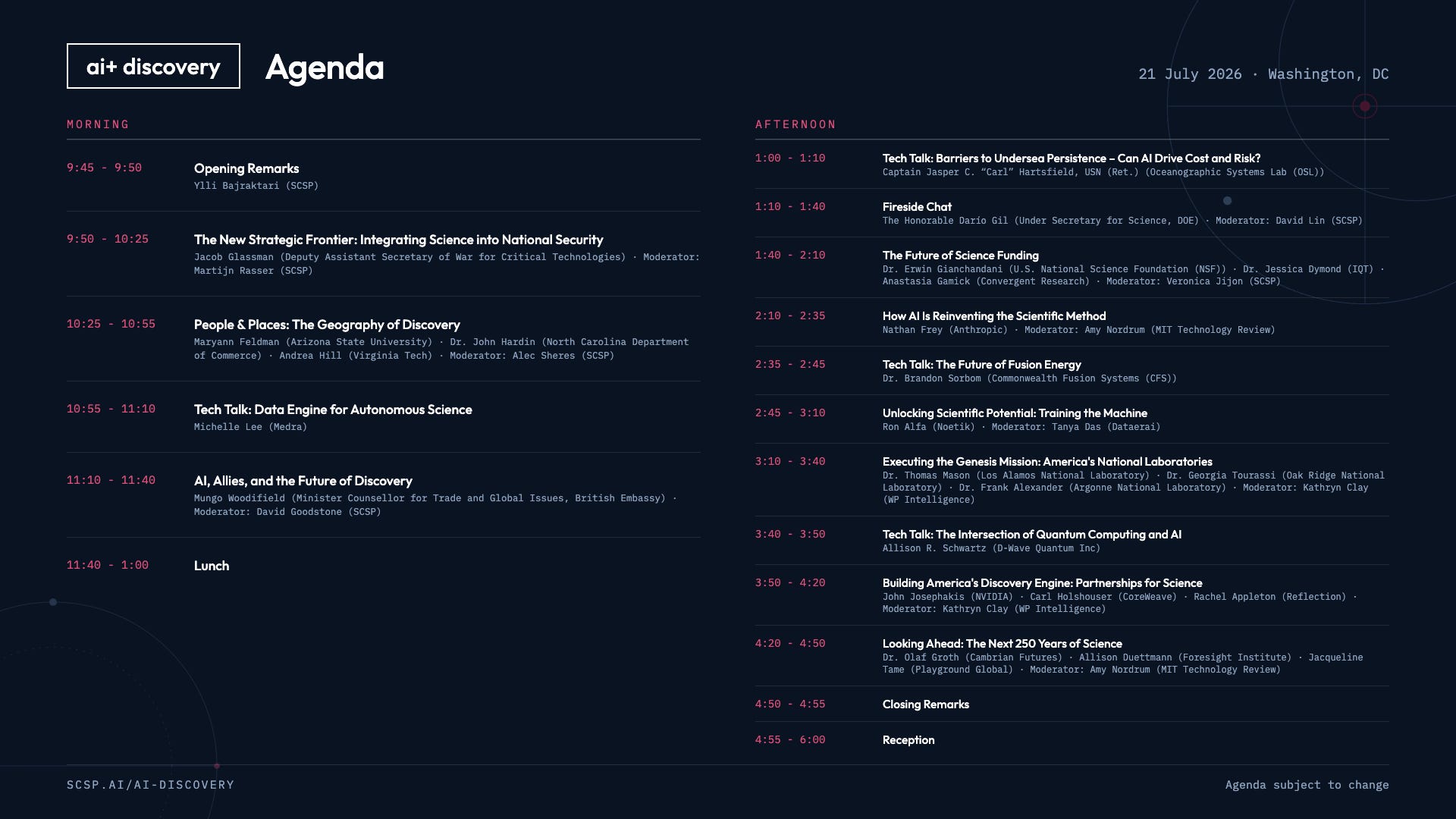
If you’re tracking how AI is evolving from a software assistant into a full-blown discovery engine, this event is for you. The agenda focuses heavily on the shift toward autonomous “scientific agents” that can design and run experiments, the scaling of next-gen compute infrastructure, and what this all means for U.S. competitiveness.
If you want to see how the R&D pipeline is being completely rewritten, you can check out the newly launched agenda and grab a spot below.
The Partnership for U.S. Leadership in Supercomputing, AI, and Quantum (PULS AIQ) convenes government, industry, academia, and philanthropy to build the case for American leadership in AI-enabled discovery. Special thanks to Tanya Das, Levi Patterson, and Jaclyn O’Day for their support in organizing the workshop. To learn more or to participate, contact SCSP.
The Latest on Strait Forward: Assessing PLA Military Readiness
China's military is testing Taiwan in new ways — fewer dramatic air incursions, and far more Coast Guard ships crowding Taiwan's waters in a slow, deliberate squeeze.
In this episode of Strait Forward, Channing Lee sits down in the Strait Forward studio with Dr. I-Chung Lai, President of the Prospect Foundation, to assess how Taiwan reads the readiness of the People's Liberation Army to conduct an operation around the island. They dig into whether Beijing has the capability for a full-scale invasion, why a blockade or quarantine may be the more realistic threat, what China might be learning from conflict in the Middle East, and how gray-zone tactics are reshaping the fight across the strait. Lai closes on a hopeful note: a Taiwan growing more economically confident and more sure of its own ability to defend itself.