

Sensing the Threat

Hello, I’m Ylli Bajraktari, President of the Special Competitive Studies Project. In this edition of our newsletter, we share an important new paper on computer vision, geo-spatial intelligence, and the future of intelligence by Shelby Pierson, who served our country honorably for more than two decades in the Intelligence Community — most recently as Director for Analysis at the National Geospatial-Intelligence Agency, where she led over 6,000 personnel and a $400 million global intelligence portfolio, and before that as National Intelligence Manager for Russia/Europe/Eurasia. She began her career as an imagery analyst.
Sensing the Threat: Operationalizing Computer Vision for Intelligence and Warfighting
In October 1962, photo interpreters discovered Soviet missiles in Cuba and gave the president thirteen days to act. Pierson’s argument starts there and ends with an uncomfortable question: what happens when the next crisis gives us thirteen hours?
America’s Problem Is Not Innovation — It Is Adoption
Her core finding should encourage as much as it alarms, because it means the hardest part is already done. Computer vision is mature. Two functions in particular are proven at scale: change detection, which flags deviations from a known baseline across wide areas, and persistent object monitoring, which tracks vehicles, vessels, and launchers across space and time. American companies and laboratories built these capabilities; what remains is to field them. Yet U.S. intelligence and defense organizations still run predominantly human-centric imagery workflows.
That gap between what is technically mature and what is operationally fielded, she writes, “is no longer an inefficiency. It is a strategic vulnerability.”
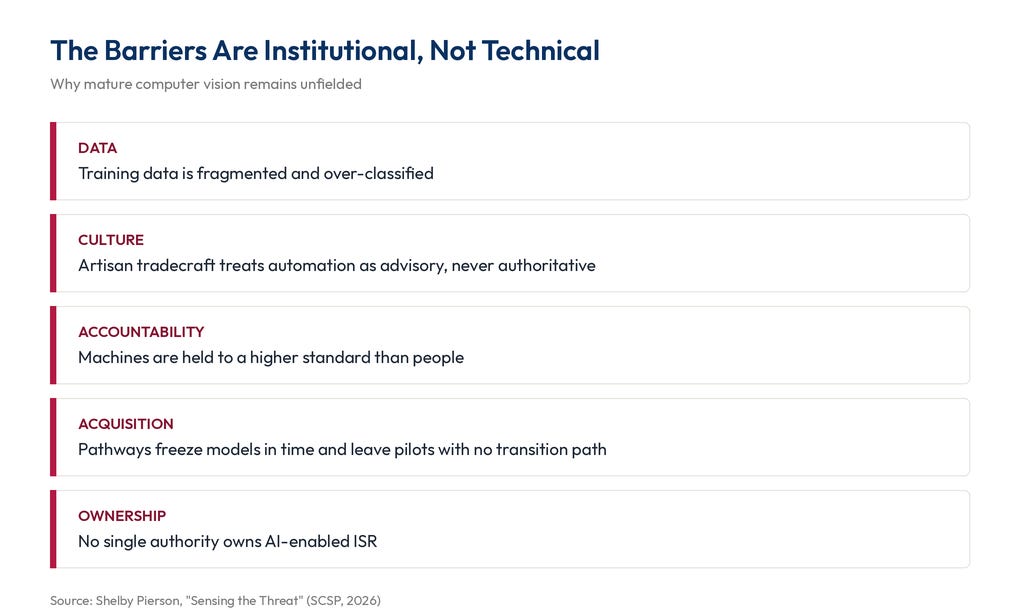
What’s holding us back is institutional, not technical. Pierson catalogs the barriers with an insider’s precision: fragmented and over-classified training data; an artisan tradecraft culture in which automation is advisory rather than authoritative; accountability structures written for human judgment that hold machines to a higher standard than people; acquisition pathways that freeze models in time and leave pilots with no transition path; and institutional fragmentation in which no single authority owns AI-enabled ISR.
Her verdict on the current pattern is blunt:
“Bolting the future onto the past is not modernization. It is a way of postponing it.”
Others Are Already Past This Debate
Our competitors are not waiting. China has chosen diffusion over exquisite performance, pushing automated change detection and persistent monitoring across echelons and mission areas and wiring it directly into command and control — persistence and scale, not perfection, generating decision-speed advantage. Israel has demonstrated the harder lesson: once operational demand exceeds human bandwidth, automation stops being a choice.
Field First
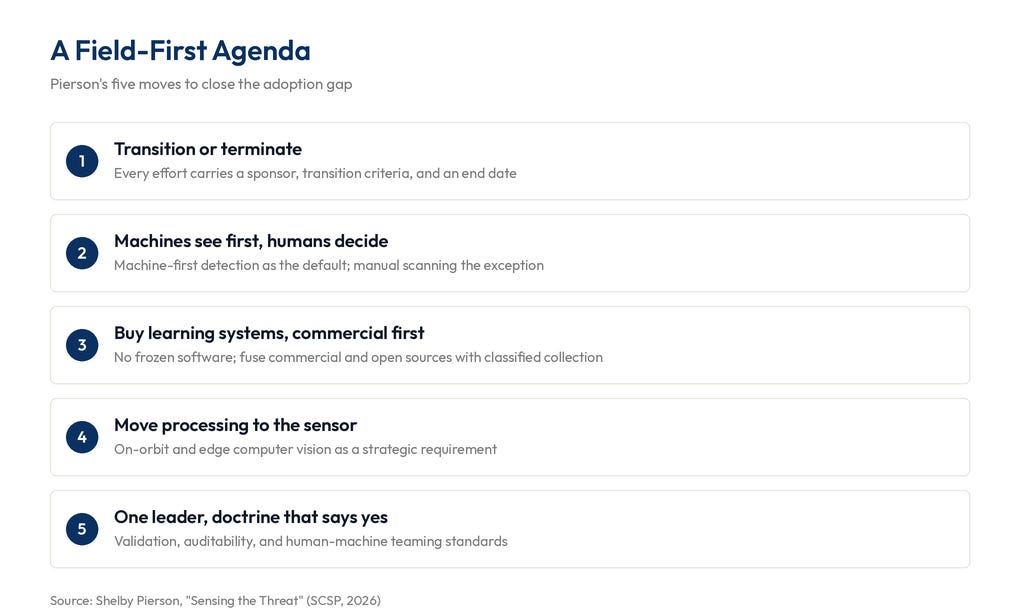
Pierson’s recommendations lead with fielding, not governance, on the argument that the United States suffers from a shortage of fielded capability, not a shortage of oversight. Every computer vision effort, she argues, should carry an operational sponsor, explicit transition criteria, and a termination date — transition or terminate. Machine-first detection should become the default and manual scanning the justified exception: machines see first, humans decide. The Department should buy learning systems rather than frozen software, and buy commercial first — fusing commercial and open sources with classified collection rather than treating them as supplementary. Processing should move to the sensor, with on-orbit and edge computer vision treated as a strategic requirement in the constellations being designed now, alongside investment in spatial intelligence and 3D world models. And one accountable leader should be on the hook, backed by doctrine that lets the enterprise say yes — validation, auditability, and human–machine teaming standards that shift the default from restriction to responsible use.
The Decisive Decade, Seen Through an Optic Nerve
Pierson frames 2026–2030 as a narrowing window, because the architectures that will carry the force for a generation are being designed today. It is the same decisive-decade clock SCSP has been pointing to since our founding, and her paper connects directly to our Offset-X work, where sensing sits alongside AI and autonomy at the foundation of a new Joint Warfighting Concept.
As she puts it, a force that invests in sensors, AI, and autonomy but fails to operationalize computer vision “has built a nervous system without an optic nerve — collecting everything and perceiving too late.”
Her closing line is the one worth sitting with — but it is also, read rightly, a statement of American opportunity: the United States retains technical superiority, but superiority unfielded is superiority forfeited. The technology is ours. The window is open. What remains is the decision to field what we have already built.