

The Re-Industrialization Roadblock: China is Dominating Robotics for Advanced Manufacturing

In today’s newsletter, SCSP’s robotics team shares the key takeaways from a new U.S.-China net assessment report highlighting the uphill battle needed to overcome China’s increasing dominance in robotics for advanced manufacturing.
Throughout the past year, Beijing has made its willingness to weaponize supply chain chokeholds undeniably clear, enacting rounds of restrictions on rare earth exports and critical component processing. For the United States, this is not just a trade irritant; it is a flashing red light for national security. As we strive to re-industrialize the American economy, we face a critical vulnerability: the machines necessary to build our future—and the components that power them—are increasingly made in China.
SCSP’s latest report, The Robot Deficit: Diagnosing the U.S.-China Competition in Robotics for Advanced Manufacturing, reveals that the competition for robotics leadership has shifted, leaving both the United States and its global allies chasing China’s rapid acceleration in this space.
The Strategic Imperative: Why Robotics Matters Now
Domestic manufacturing capacity is a strategic asset that the United States needs to rebuild, yet structural bottlenecks make such an objective unsustainable with current infrastructure. Persistent labor shortages and demographic pressures have elevated robotics from an efficiency tool to an industrial necessity. In a high-wage economy facing a projected shortage of nearly 2 million manufacturing workers by 2033, robotic automation is needed to make re-industrialization feasible and sustainable, while creating new high-quality jobs. Additionally, strategically important leading edge technologies, such as semiconductors and quantum devices, that cannot be manufactured by humans at scale due to precision, repeatability, and contamination constraints, making robotic adoption a prerequisite for production.
U.S. leadership across the robotic lifecycle is needed to safely accomplish this goal because relying on foreign robotics creates significant vulnerabilities. Networked robots live at the cyber-physical intersection, meaning that risks range from exposing sensitive information to interference with critical infrastructure. In the event of a trade disruption, the United States currently lacks the surge capacity to build and maintain the automation tools necessary for societal and defense resilience.
The Tech Scorecard: A Tale of Two Ecosystems
Our assessment uses the SCSP Tech Scorecard to diagnose the structural divergence between the two powers. While the United States maintains a lead in cutting edge innovation and capabilities driven by its software prowess, it lacks the industry, market, and talent pool to match China’s growing dominance. These weaknesses are compounded by the lack of a unified, actionable U.S. strategy to match China’s whole-of-country push in this sector.
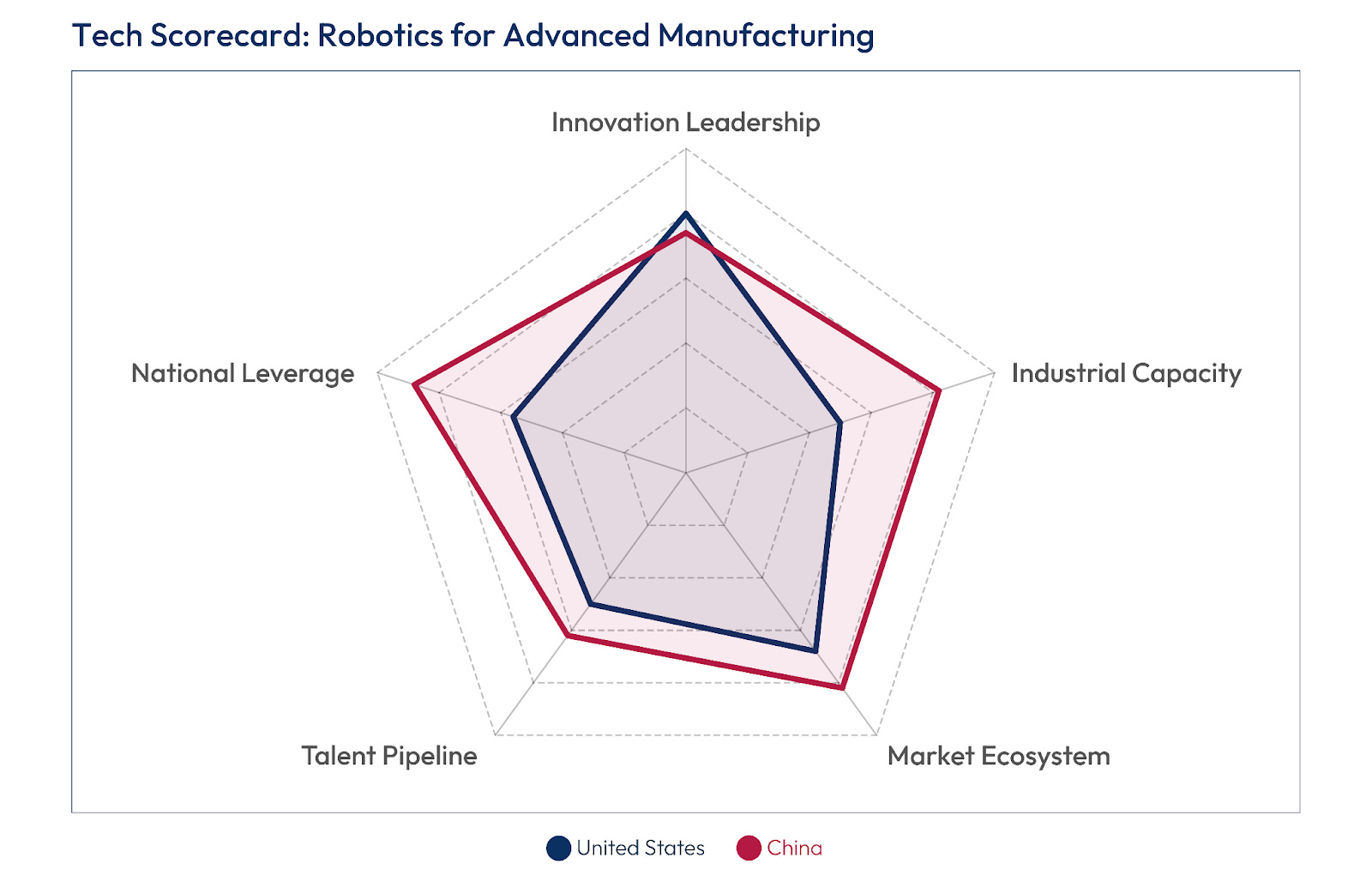
In less than two decades, China has risen from a minor player in the robotics industry to now being the market for the majority of new installations in the world, producing the majority of its new robots domestically, and becoming a net exporter of industrial robotics systems. Beijing kickstarted this growth with a coordinated “whole-of-country” strategy, utilizing state-backed vehicles like the $1.4 billion “Big Fund” to nurture a production capacity and adoption demand no other country can match. China’s massive domestic market creates a self-reinforcing loop. High adoption rates generate economies of scale, and perhaps more important real-world training data to rapidly iterate and improve. China’s systems for the most part are simpler than global innovation leaders, optimized for structured, predictable environments rather than complex, unstructured ones. However, even this area is at risk of becoming China-dominated as research, patents, and capability benchmarks are starting to trend towards China.
The U.S. ecosystem, on the other hand, is defined by brilliance at the top but brittleness at the base. The United States retains the edge in the “brains” of robotics—cognitive software, AI integration, and Vision-Language-Action (VLA) models. We lead in creating intelligent systems capable of reasoning and operating in unstructured environments. This strength is reinforced by capital markets, where investment in high-margin robotic software is booming. However, the United States is unable to translate these strengths into broader industrial robotic leadership because it lacks both the supply–ability to produce robots and their subcomponents domestically–and the demand–a customer base of manufacturers to adopt U.S. robotics systems. Both of these issues are compounded by talent shortages and the lack of a national strategy.
The Bottom Line
The window to address this deficit is closing. China’s dominance is likely to grow absent a concerted U.S. effort to create the strategy, investment, and adoption incentives needed to jumpstart the domestic sector. We cannot win the 21st century by only building the software while our competitors build the machines that run the world. SCSP’s recently announced National Security Commission on Robotics for Advanced Manufacturing will help set the United States on the right path to overcome these challenges and change the trajectory. This commission will provide U.S. leaders with the strategy to prevail in this era of intensified competition by controlling the frontier of next-generation robotics and advanced manufacturing.
Now available: a new episode of NatSec Tech!
In the latest episode of NatSec Tech, Jeanne Meserve sits down with Dr. Erik Brynjolfsson, Director of the Stanford Digital Economy Lab and a member of the newly formed Task Force on AI and the Future of Work.
The stakes couldn’t be higher. Dr. Brynjolfsson argues that AI is currently racing ahead of our economic institutions and that the U.S. is at a critical crossroads. Will we lead the most advanced workforce in human history?