


In today’s newsletter, SCSP’s Government Affairs team details how SCSP’s three most recent initiatives in workforce, quantum, and robotics advance the mission to secure the United States’ competitive edge.
Over the past several years, the conversation around emerging technology has often focused on breakthroughs—new models, new systems, new discoveries. But for many Americans, the impact is showing up somewhere more familiar: in job searches, on factory floors, and in local economies trying to adapt to change.
The Labor Market. Recent college graduates are entering a labor market where entry-level roles are shifting or disappearing, even as employers struggle to find workers with the right technical skills. Jobs that once served as stepping stones are being redefined by AI tools that can now handle parts of that work.
The Factory Floor. In manufacturing communities across the country, the question is not just whether factories will return, but what those factories will look like and who will work in them. Globally, competitors are investing heavily in robotics and automation, with China now accounting for over half of global industrial robot installations and establishing a decisive lead in robotics for advanced manufacturing.
The Quantum Future. Quantum technologies are advancing rapidly, showing early signs of commercialization and accelerating public and private investment, with the potential to reshape industries from pharmaceuticals to finance. As breakthroughs in quantum information sciences bring practical applications closer, the gradual reordering of technological advantage in areas like drug discovery, materials science, and secure communications is coming into view.
These changes are not abstract. They are already influencing hiring decisions, investment patterns, and the economic trajectory of communities across the United States.
In response, SCSP launched three coordinated efforts focused on AI and the future of work, robotics for advanced manufacturing, and quantum technologies—each designed to translate technological change into durable U.S. advantage. All three initiatives bring together stakeholders from industry, government, and academia, supported by expert advisors, and will follow an approximately one-year trajectory to develop actionable recommendations.
Workforce at a Crossroads
For many workers, AI is no longer a distant concept. It has already changed daily tasks, altered hiring expectations, and reshaped career pathways.
SCSP’s Task Force on AI and the Future of Work, launched in partnership with NVIDIA, is built on a straightforward conviction: the United States can lead the world in artificial intelligence and ensure that American workers are not left behind in the process. Building on SCSP’s foundational work on AI competitiveness, the Task Force brings together leaders from government, industry, and academia to confront three practical challenges: defining the skills that the AI economy will demand, designing a strategic roadmap for decision makers that connect workers to employers and educational institutions, and developing policies that ensure the benefits of AI are broadly shared. The goal is not just U.S. leadership in AI, but a digital revolution in which the American worker is central to the story.
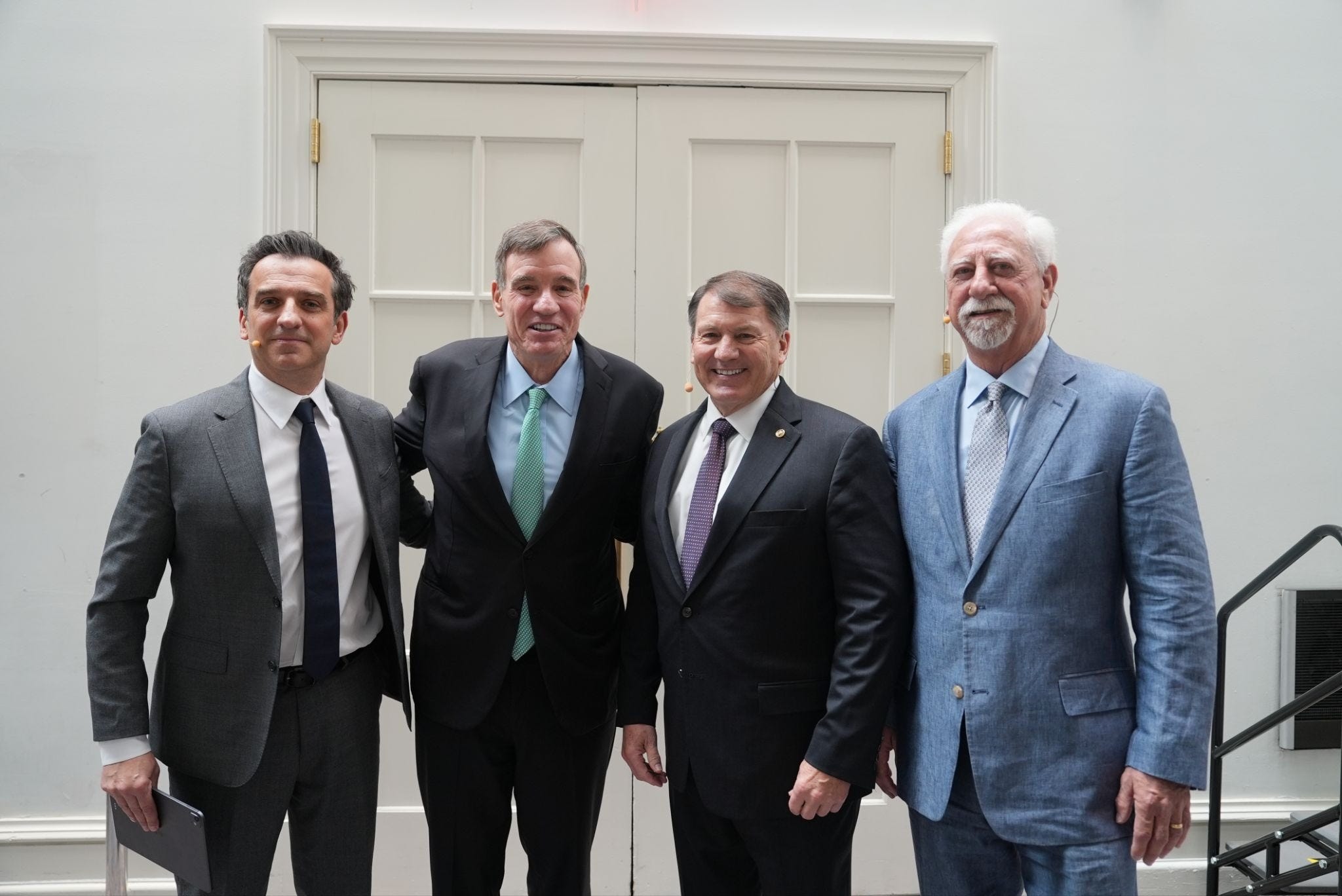
The Task Force is co-chaired by Senators Mike Rounds (R-SD) and Mark Warner (D-VA), alongside SCSP President Ylli Bajraktari and NVIDIA co-founder Chris Malachowsky. The Senate co-chairs—who recently demonstrated their shared commitment to these issues by introducing legislation to establish a commission on the future of the American economy— offer complementary perspectives that reflect the wide-ranging impact of AI on the American workforce.
Senator Warner represents a state at the heart of the nation’s technology and data infrastructure, a viewpoint he pairs with his focus on the national security implications of emerging tech on the Senate Select Committee on Intelligence (SSCI). Senator Rounds broadens this lens through his service on both the SSCI and the Senate Armed Services Committee (SASC), directly connecting these national security priorities to workforce development in rural and regional economies. He has seen firsthand how institutions like Dakota State University bring these priorities to life by training students in cybersecurity, data, and applied AI.
The Task Force is focused on practical questions: What skills will be needed five years from now? How do you retrain mid-career? How do education systems keep pace? Its goal is to design pathways that connect people to opportunity, building the bridge between today’s workforce and tomorrow’s economy.
Robotics for Advanced Manufacturing: A National Security Imperative
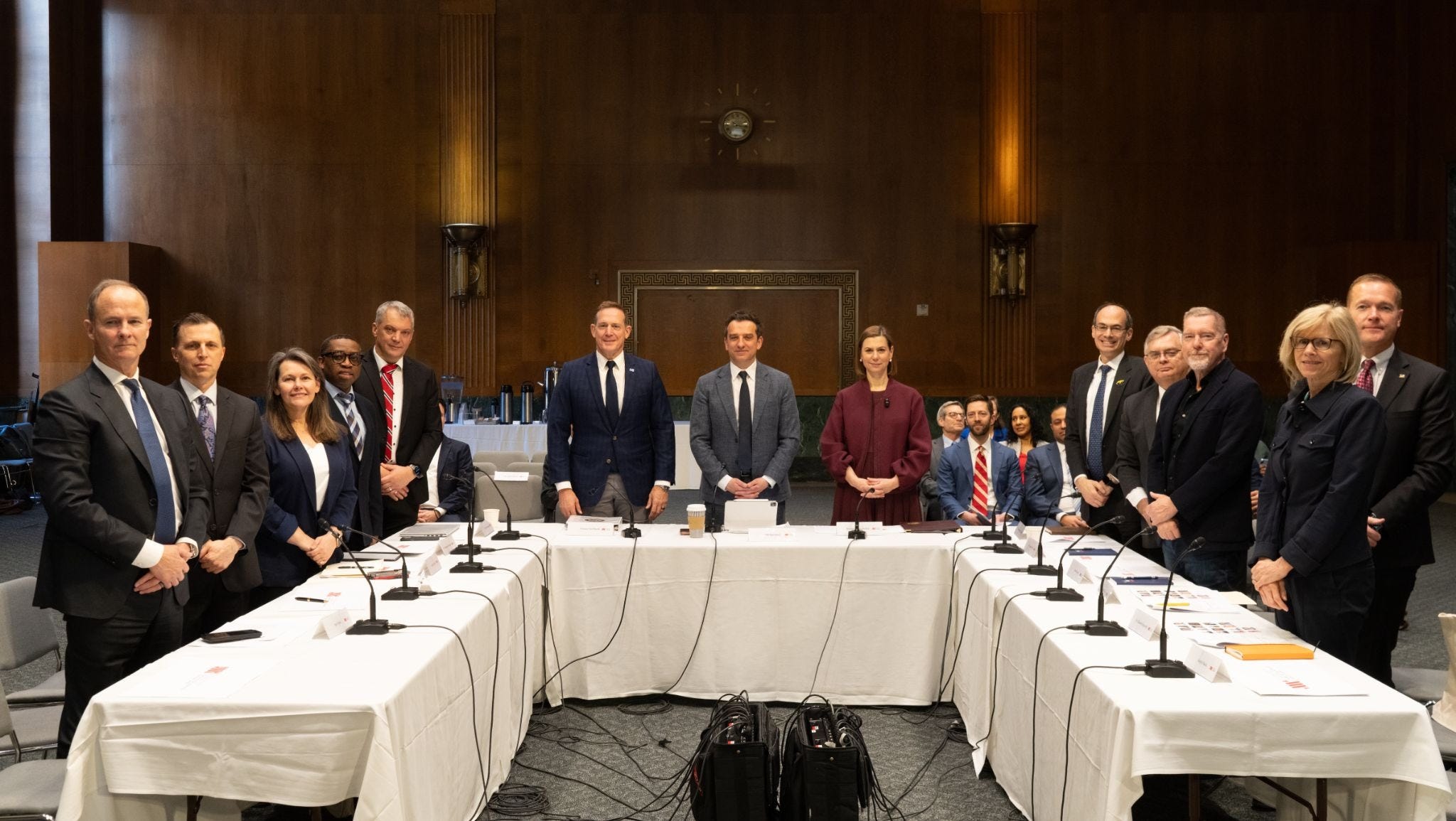
In manufacturing communities, the stakes are equally material. For workers, this shift is visible on the factory floor, where software, physical AI, and machines are increasingly integrated into production. But at a national level, the implications are even broader: the same systems that strengthen local economies also determine how quickly and reliably the United States can produce critical technologies.
The National Security Commission on Robotics for Advanced Manufacturing was launched to tackle this exact challenge. The Commission’s primary goal is to develop a comprehensive national strategy for robotics and physical AI that ensures U.S. industrial capacity remains a strategic advantage. Specifically, it will focus on scaling the adoption of next-generation production systems, strengthening the manufacturing workforce pipeline, aligning public and private investment, and ensuring the United States can seamlessly translate innovation into hard production capacity.
To lead this effort, the Commission is co-chaired by Senators Ted Budd (R-NC) and Elissa Slotkin (D-MI). Both senators bring deep, complementary expertise at the intersection of manufacturing policy and national defense.
Senator Slotkin represents a state that helped define modern industrial production and is now evolving through robotics, advanced mobility, and a renewed tie to defense production. She brings a vital national security lens forged during her career in the Intelligence Community and the Department of Defense. Currently serving on SASC, she understands how a robust domestic manufacturing base underpins military readiness and supply chain resilience.
Senator Budd represents a state with a dynamic research ecosystem—anchored by the Research Triangle —and a rapidly growing base of advanced manufacturing. Alongside his own seat on SASC, he serves as the Chair of the Senate Commerce Committee’s Manufacturing Subcommittee. This dual vantage point uniquely positions him to bridge the gap between defense requirements and commercial manufacturing innovation.
Together, their leadership grounds the Commission’s work in a stark reality: translating innovation into production is not just an economic imperative, but a national security priority. This effort builds on SCSP’s earlier work, including the National Action Plan for Advanced Manufacturing and prior memos on robotics and industrial capacity, which highlight the urgent need to close the “valley of death” between invention and deployment. Ultimately, this Commission will help determine whether the United States leads the world in robotics-enabled manufacturing or relies on others for critical production capacity.
The Quantum Horizon
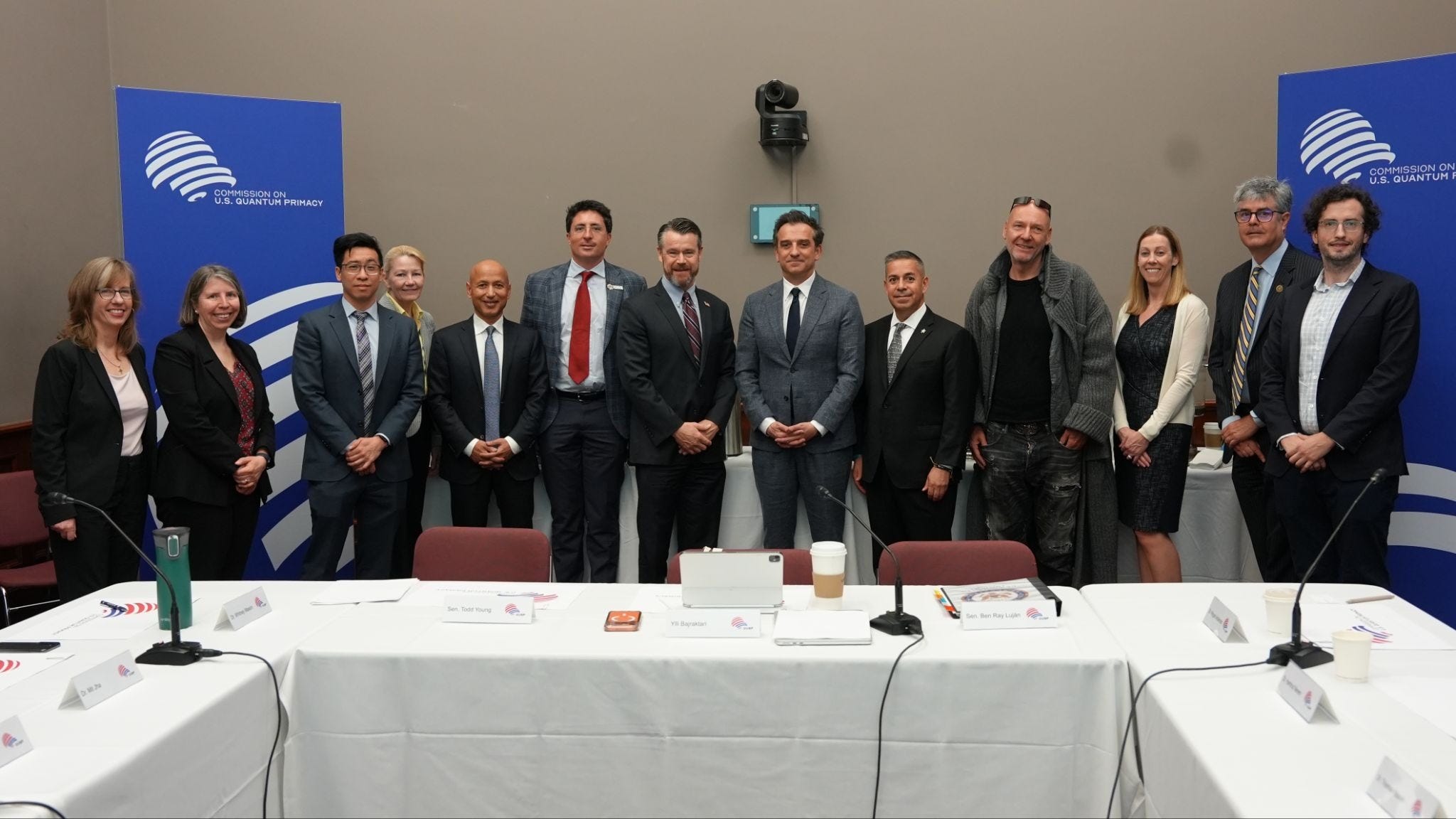
Quantum is no longer theoretical; it is rapidly transitioning from theoretical physics to operational reality. As these technologies move from the lab to real-world deployment, they have the potential to accelerate drug discovery, optimize logistics, and fundamentally break—or secure—the encryption systems that protect financial transactions and national security information.
Because the window to secure a sustained lead in this space is narrowing, SCSP launched the Commission on U.S. Quantum Primacy. The Commission’s mission is to develop a comprehensive national strategy to ensure the United States defines the quantum age rather than merely participating in it. Specifically, it will focus on three core pillars: building a secure quantum industrial base, including hardware and supply chains; maintaining an information advantage through mission-critical algorithms; and accelerating the integration of quantum systems with classical technologies for near-term operational use.
To guide this massive undertaking, the 14-member commission, which bridges leadership from the private sector, national laboratories, academia, and government, is co-chaired by Senators Todd Young (R-IN) and Ben Ray Luján (D-NM). Both senators sit on the Senate Commerce, Science, and Transportation Committee, where they recently partnered with a bipartisan group of members to introduce the National Quantum Initiative Reauthorization Act, a bid to sustain U.S. leadership in quantum technologies.
Senator Young approaches quantum as a critical component of outcompeting foreign adversaries and safeguarding American economic and national security. Beyond his Commerce Committee role, his seats on the Senate Foreign Relations Committee and SSCI deeply inform his push to secure America’s global tech leadership. He represents a state where investments in advanced industries and defense-related innovation hubs are turning the Midwest into a critical player in emerging tech.
Senator Luján brings a perspective deeply rooted in the American scientific research engine. In New Mexico, national laboratories like Los Alamos and Sandia are not just anchors of the local economy—they are leaders of the nation’s quantum research efforts (with directors from both labs serving on this very Commission). Senator Luján understands exactly how to leverage these world-class research institutions to transition basic science into applied national power.
For both senators, the issue is not conceptual. It is about ensuring that these opportunities—and the massive industries they will enable—take root in the United States.
This work builds seamlessly on SCSP’s broader technology portfolio, including the National Action Plan on Advanced Compute and our ongoing analysis of emerging technology competition, such as the quantum edition of our Memos to the President series. As SCSP has maintained, quantum represents a fundamental shift in the landscape of national power—one that will redefine both economic competitiveness and national security for decades to come.
A Proven Model for Action
These three new initiatives are not starting from scratch. Each follows the successful structure of SCSP’s Commission on the Scaling of Fusion Energy, which recently brought together bipartisan policymakers including Senator Jim Risch (R-ID), and Senator Maria Cantwell (D-WA) as co-chairs, industry leaders, and technical experts to produce concrete, actionable recommendations.
The SCSP model is consistent and intentional across the AI, Robotics, and Quantum efforts: assemble the right cross-sector stakeholders, focus strictly on implementation rather than just theory, and deliver results on a defined, roughly one-year timeline. The goal is not merely to study these emerging technologies, but to provide a clear, executable playbook for U.S. leadership.
Why This Matters Now
Across the country, the shifts driven by these technologies are already a daily reality.
A recent graduate navigating a rapidly changing job market.
A technician learning to work alongside—and integrate—new physical AI machines on the factory floor.
A community investing in advanced manufacturing or expanding its quantum research capacity.
The AI workforce, robotics, and quantum computing will definitively shape the next phase of the American economy and the future of global security. But their impact will entirely depend on how effectively the United States develops its talent, builds its industrial capacity, and translates rapid innovation into real-world outcomes.
These three new SCSP efforts are designed to do exactly that. Each having formally met for the first time this month, the task force and commissions are eager to get to work, ensuring that the United States doesn’t just adapt to the future, but builds it.